Share the page
In Sierra Leone, Jolaks is focusing on the local processing of palm oil
Published on
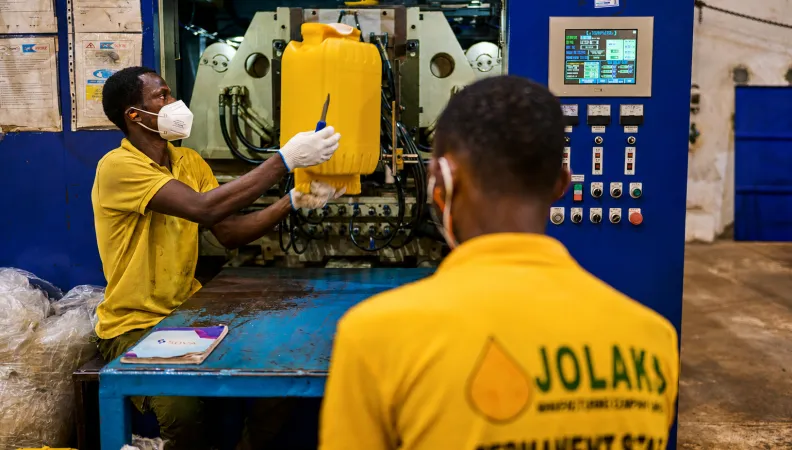
At its Freetown refinery, the family-run company Jolaks processes up to 300 tonnes of crude palm oil into edible oil every day. Support from Proparco under the ARIA initiative is enabling the company to expand its production capacity and improve food security in Sierra Leone. On the ground, business leaders, farmers, traders and public officials talk of an activity that provides an essential part of the staple diet of Sierra Leoneans and brings together local small producers, industry and commercial outlets. Report.
Yellow jerrycans stacked in compact rows form walls beneath the warehouse’s steel framework. A few metres away, operators wearing polo shirts in the same colours monitor the filling line. Translucent containers move along the conveyor belt. A little further on, a few samples of various shades of oil are lined up in front of the control screens. Out front, mobile tanker trucks idle noisily under the blazing sun. Large hoses like giant boas empty their precious cargo into semi-buried tanks: crude palm oil, red as the earth and indigestible, ready to be transformed – after rigorous processing – into the edible palm oil consumed every day in Sierra Leone.
Short circuit
Welcome to the Jolaks industrial plant, right in the heart of the capital, Freetown. In Sierra Leone, which has to contend with numerous food security challenges, there is fresh political will to make the country more self-sufficient in the production of staple foods, which include palm oil. The site’s operations are a tangible expression of this objective, as described by Ekta Nandwani, “born and bred in Freetown” and a Director of Pee Cee Holding Limited, Jolaks’ parent company: “We have access to palm oil here and we have the land, so why not ensure that the country can become self-sufficient?”
According to its Managing Director, the Jolaks Manufacturing refinery can process up to 300 tonnes of crude palm oil a day into palm oil for use in cooking. The aim is to produce locally, provide a market for farmers in the region, and bring to market oil sold directly in market stalls across the country.
US$20 million worth of funding
The path towards this goal of food self-sufficiency leads through ARIA, which stands for Africa Resilience Investment Accelerator. This initiative is supported by Proparco and aims to promote investment in the most fragile economies. Valerie Entsiful, ARIA Country Manager for Sierra Leone, explains that the programme emerged out of the realisation that capital flows across the continent are unevenly distributed. She describes the origins of the Jolaks project:
“Every year, we organise a prospecting mission that brings together development finance institutions from around the world to engage with companies in the project development phase. During one of these missions, Proparco met Jolaks. The company’s objectives were very clear, both in terms of food security and creating jobs for young people in Sierra Leone.”

These impacts were in phase with those sought out by Proparco, leading to a significant financing partnership. Sadio Dicko, Proparco’s Regional Director for Western Africa, describes Jolaks as a “key player for the Sierra Leonean population”:
“We have supported Jolaks with a $20 million financing package. This will enable the company to expand its production capacity in order to process more palm oil locally, thereby securing the supply of this staple commodity for the people of Sierra Leone.”

For Ekta Nandwani, the value of the partnership between Proparco and Jolaks goes way beyond the funds committed:
“For us, it’s not just about the money, we are also acquiring know-how. We have ambitious goals: to grow Jolaks and to show the rest of the world what Sierra Leone has to offer.”
“A regular and profitable outlet”
The other aspect of the project lies upstream from the refinery, with the palm oil producers. Ekta Nandwani says she maintains excellent relations with the farmers. Until now, she explains, some had nowhere to deliver their produce and simply saw it go to waste. The opportunity to sell it to Jolaks offers them the possibility of producing more and boosting their income.
For local producers, Jolaks represents a regular and profitable outlet, which secures their income and incentivises production:
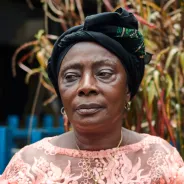
“I started working with Jolaks in 2001. They’ve already helped me a great deal and I have an excellent relationship with them. They pay us a good price, so we always come back to them.”
The supply chain extends all the way to the market in Freetown. Standing in front of the tightly packed shelves of a small store, a shopkeeper explains that he has been working with Pee Cee & Sons for over fifteen years. He sells rice products, sugar, and of course, palm oil produced by Jolaks: “Some people buy for the quality, others for the reasonable price. The two factors combined mean that we can sell a lot more,” he observes, before quoting a proverb: “Small streams turn into great rivers.”
Jobs, imports and food security
The growth of companies like Jolaks meets a threefold objective for Sierra Leone: creating jobs, reducing imports and improving food security:
“We used to be net importers of vegetable oil but Jolaks is one of the players in this sector that now enables us to be net exporters.”

The minister affirms that palm oil production has grown recently “by at least 8% to 10% every year”. He refers to investments in smallholder farms as well as in larger-scale farms designed to support the smallholders. Behind the figures and infrastructure, the minister emphasises the tangible impact the company’s success can have on families: “If this company succeeds, families will be able to send their children to school and have access to enough food, thereby reducing food insecurity.”
More broadly, this politician is encouraged by the development of major private sector players in sectors such as rice, onions, palm oil and flour: they create jobs, are financially sound and help to reduce imports.
A country open for business with major potential
Jolaks represents more than just a company: it exemplifies the potential of a country seeking to make the most of its resources, develop its industry and forge international partnerships. Alpha Ibrahim Sesay, Sierra Leone’s Minister for Trade and Industry, refers to the manner in which it strengthens diplomatic and economic ties between Sierra Leone and France:
“Take Freetown, for example: there are numerous investment opportunities here in tourism and agriculture and these are sectors in which French companies have a wealth of experience. More generally, we are identifying opportunities similar to Jolaks to promote our country and ensure that everyone knows we are open for business.”

Read also
Beacon Power Services: harnessing data to drive Africa’s energy transition
Published on April 23, 2026