
Share the page
In India, vineyards faced with climate change
Published on

Private Sector & Development - Business & Climate: Acting to transform
Proparco has published a new edition of its Private Sector & Development magazine, focusing on the strategic role of the private sector and financial institutions in tackling the climate emergency.
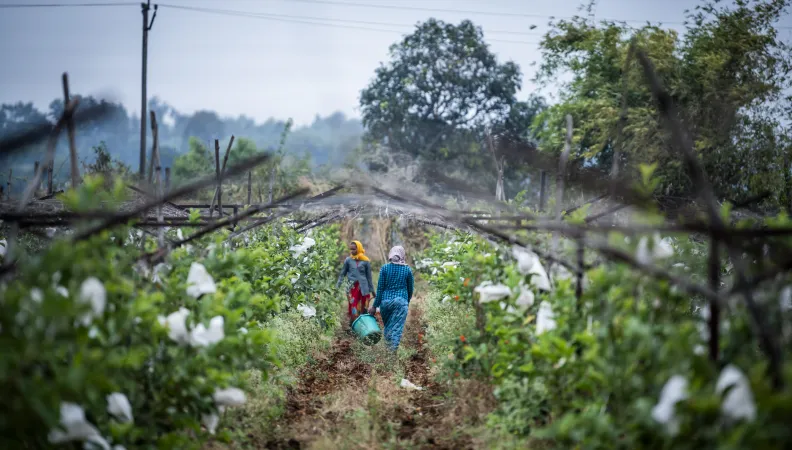
In the Indian state of Maharashtra, the Sahyadri Farms (a farmer collective owned company) – supported by Proparco – has managed to build a network of 50,000 smallholder farmers and become the country’s largest exporter of fresh grapes and other crops. It harnnesses technological innovation and agricultural research to provide access to varieties that are more resistant to climate change.
L ocated in the rural district of Nashik – a five-hour drive from Mumbai, India’s economic hub – the headquarters of Sahyadri Farms is an impressive sight. With its “neat roads lined with flower beds”, as described by Le Figaro French newspaper which visited the site in late 2022, this campus employing more than 6,000 people, set amidst vineyards and fruit plantations, is an impressive site for visitors
Less than 15 years ago, there was nothing around here but fields and a few cultivated patches. Then, in 2011, a handful of farmers – around ten initially – got together to create Sahyadri Farms, a big project run solely by… smallholder producers.
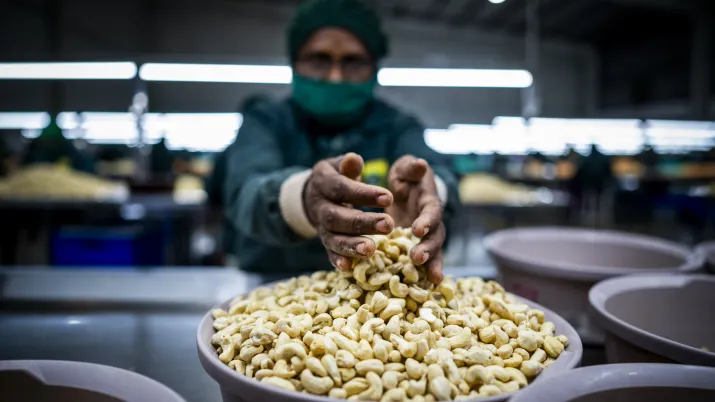
A bold and winning strategy. Sahyadri Farms is currently India’s biggest exporter of fresh grapes1 and processed fruit (such as tomatoes, mangoes, sweet corns and cashew nuts). Some over 50,000 farmers – spread over 50 kilometres – supply Sahyadri Farms with fresh produce, while 21,500 are directly owned by the organisation.
A complete ecosystem, from field to table
“Last year, we produced and processed more than 250,000 tonnes of fresh produce, both for export and the domestic market. We’re targeting 300,000 tonnes this year”, explained in 2023 Santosh Deoram Watpade, the cooperatve’s Chief Financial Officer. Sahyadri Farms partners its farmers, from crop selection to farming practices, including the inputs they use and how they harvest and sell their produce. The company is now fully tech-enabled and integrated into the value chain of 8 horticulture crops, from pre-harvest and post-harvest (i.e., sorting/ packing/processing of fruit and vegetables), to distributing to consumers in both the Indian and international markets (B2B and B2C).
1 hectare
Over 95% of the farmers who work for Sahyadri Farms or are associated with the cooperative are smallholders growing less than one hectare of vines or other crops.
Objective: zero net emissions
In 2022, Proparco co-invested in Sahyadri Farms, alongside Incofin Investment Management, FMO and Korys, for a total amount of 310 crore rupees (almost €35 million) and again in 2024 with an investment of 390 crore rupees (approximately 40 million euros). “This investment will bolster our export markets for all of our crops and increase our capacity”, explains Santosh Deoram Watpade. The investment has also enabled the cooperative to finance its new biogas plant, with a capacity of 1.6 megawatts of electricity based on a process of fermentation of organic matter. “Our aim with this new plant is to achieve carbon neutrality (i.e., zero net emissions),” adds Rupesh Khiste, Head of R&D and Projects at Sahyadri Farms.
For a long time, enterprise in rural India – where 60% of the population lives – was non-existent. But over the last ten years or so, the situation has changed: attitudes are evolving and projects are proliferating although access to capital remains a major obstacle.
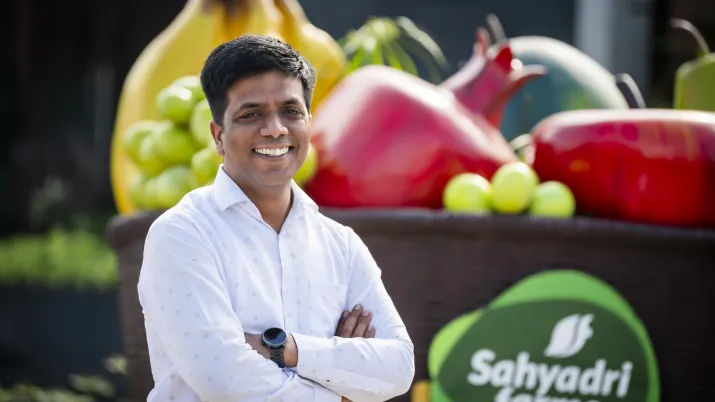
- Founder and CEO of Sahyadri Farms

For Sachin Kadam, union is strength
“Here, every voice counts”. On the path down to his 12 hectares of vines, just below his house, Sachin Kadam is adamant: “One farmer, one vote. That’s the principle behind the Sahyadri Farms project”. This farmer, who specialises in growing fresh grapes, joined the cooperative a few years ago. “All of the farmermembers together decided on the major focuses and strategic choices for guiding the future of the cooperative. That’s what constitutes the strength of this project.”
The benefits for his farm have been quite spectacular: Sachin has increased the areas under vines five-fold and now exports 80% of production to Asia and Europe. He has also benefited from technological progress that he could never have accessed on his own. “The agricultural expertise of Sahyadri Farms teams and their innovative approaches have revolutionised my practices,” he readily admits. “Before, I had to battle the bad weather that was ravaging my crops.” Since then, Sachin has grown Thompson grapes - a hardier, seedless variety from California - upgraded his vines and received regular support from agricultural engineers.
This cooperative-based system means that the farmers involved in the venture - most of whom grow less than one hectare - receive regular, predictable incomes. This is vital, given that 80% of people living below the poverty line in India are small farmers 2 . “The Sahyadri Farms project protects its members. We can estimate our income in advance, invest and even expand ”, explains Sachin, who recently had a new house built, as well as a greenhouse that allows him to dry some of his grapes and other crops (especially tomatoes).
18 % of GDP
India is the world’s second largest agricultural producer. Agriculture employs over 40% of the working population and accounts for 18% of the country’s gross domestic product.
Innovating to adapt to climate change
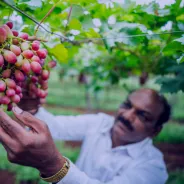
I n the village of Kone – over an hour’s drive from the district of Nashik – Bashkar Vishnu Kamble, a member of Sahyadri Farms, grows almost 10 hectares of Thompson vines, a variety long renowned for its ability to cope with bad weather. But with climate change – which in these latitudes takes the form of a violent rainy season and a scorching summer – Bashkar has to adapt. Landslides, floods, heatwaves, cyclones, droughts and dust storms... The Indian subcontinent is one of the world’s most disaster-prone regions. In an attempt to cope with these natural disasters and anticipate better crop yields, Bashkar has planted two hectares of a new red grape variety, ARD36.
“It’s a crisp, sweet table grape that copes especially well with extreme weather conditions and is also very popular in export markets”, explains Pankaj Nathe, who heads up the agronomic research team at Sahyadri Farms. At the heart of the Cooperative’s campus, this agricultural engineer has developed this new-generation vine on around one hectare of land, as well as other red and white grape varieties, which he monitors like a saucepan that can boil over any time. “We test them here in real conditions. Every day, we track the development of the grapes and their resistance to rain, heatwaves, disease and so on. This is vital if we are to anticipate the effects of climate change and explore new markets.”
To help with soil regeneration, Bashkar will also be planting hedges at Kone. “Rising temperatures are disrupting climate conditions and upsetting the natural balance”, notes the farmer. “We all need to do our bit.”
Landslides, floods, heatwaves, cyclones, droughts and dust storms... The Indian subcontinent is one of the world’s most disaster-prone regions.
Discover our interviews
Sahyadri Farms, trailblazes with agricultural business and finance model
Published on January 14, 2026
Key figures
- 1er exporter of fresh grapes
- + 50 000 smallholders keep the cooperative supplied
- 21 500 of these farmers are shareholders in Sahyadri Farms
Further reading

How emerging countries innovations can scale climate resilience for all
Published on November 25, 2025