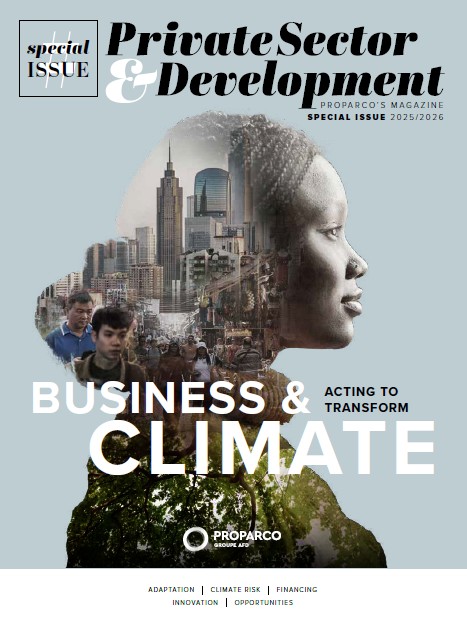
Proparco has published a new edition of its Private Sector & Development magazine, focusing on the strategic role of the private sector and financial institutions in tackling the climate emergency.
Faced with the worsening physical impacts of climate change, adaptation is gradually becoming an economic and financial priority. Long perceived as a renunciation of mitigation, it is now becoming indispensable, including for central banks and supervisors.
Why has adaptation become a priority in recent years?
Ten years ago, Mark Carney1 gave a now famous speech on the ‘tragedy of the horizon’: the tragedy of climate change was that its impact was relatively invisible at the time because it lay beyond the horizon of decision-makers.
There can be no adaptation without climate stability, and no climate stability without a ‘net zero’ situation.
At the same time, and up until recently, there was also a reluctance to talk about adaptation. Emphasising the need to prepare our economies and societies for climate change was seen as carrying the risk of giving up on fairly ambitious climate action. This reluctance is not entirely unfounded, especially since adaptation is not an alternative to mitigation: there can be no adaptation without climate stability, and no climate stability without a ‘net zero’ situation.
Ten years on, unfortunately but inevitably, the impacts of climate change have become very real, with new records and disasters week in, week out. Globally, the average annual cost of climate damage has increased by more than 30% between the 2005-2015 decade and the 2015-2025 decade. Everyone is affected, but certain less developed economies are on the front line.
These more severe and frequent impacts make the need for adaptation even more urgent. Adaptation – more than mitigation – is perceived as a cost that raises questions about who will bear the burden.
Nevertheless, is adaptation not something that is quite far removed from the mandate of central banks and prudential supervisors?
The financing of adaptation is obviously more of a fiscal issue (even though some projects may be undertaken and financed by private actors). One may claim that adaptation is not a matter for a central bank or a prudential supervisor and this objection was raised by some when the NGFS began working on the subject in 2023. However, before being a question of financing, adaptation is about what to adapt to and why to adapt. The aim is to limit the impacts of climate change.
However, before being a question of financing, adaptation is about what to adapt to and why to adapt.
This phenomenon is particularly visible in the United States, where insurance premiums in the most exposed counties have increased by more than 20% between 2020 and 2023 (twice as fast as the average) and now amount to tens of thousands of dollars per year. Indeed, these rate increases are not even enough, and many insurers have announced that they are withdrawing from certain regions. While this situation is extreme (developments in France and Europe are much less dramatic), it is obvious that the insurability of climate risks can no longer be taken for granted.
Nevertheless, the work of the NGFS suggests that the development of insurance in emerging and developing economies remains a relevant objective and provides a better understanding of how the organisation of the insurance market can help preserve the insurability of climate risks. It has also illustrated the value of certain approaches (e.g. parametric insurance) in making insurance more effective and developing it more rapidly in jurisdictions where coverage is low. However, it has also highlighted the fact that insurance cannot ignore the dramatic increase in risk, and that adaptation is an essential dimension of preserving insurability.
Climate change presents a specific challenge to the insurance sector, which can provide a response to societal management of physical risks.
This phenomenon is particularly visible in the United States, where insurance premiums in the most exposed counties have increased by more than 20% between 2020 and 2023 (twice as fast as the average) and now amount to tens of thousands of dollars per year. Indeed, these rate increases are not even enough, and many insurers have announced that they are withdrawing from certain regions. While this situation is extreme (developments in France and Europe are much less dramatic), it is obvious that the insurability of climate risks can no longer be taken for granted.
Nevertheless, the work of the NGFS suggests that the development of insurance in emerging and developing economies remains a relevant objective and provides a better understanding of how the organisation of the insurance market can help preserve the insurability of climate risks. It has also illustrated the value of certain approaches (e.g. parametric insurance) in making insurance more effective and developing it more rapidly in jurisdictions where coverage is low. However, it has also highlighted the fact that insurance cannot ignore the dramatic increase in risk, and that adaptation is an essential dimension of preserving insurability.