
Share the page
Sahyadri Farms, trailblazes with agricultural business and finance model
Published on
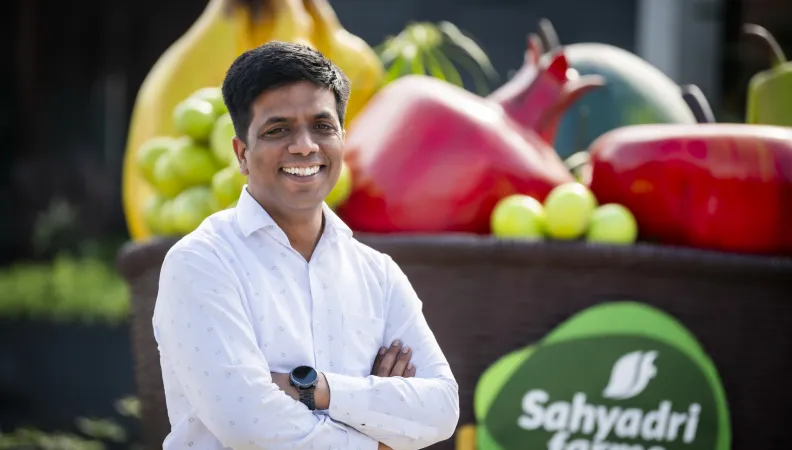
Santosh Deoram Watpade CFO Sahyadri Farms

Private Sector & Development - Business & Climate: Acting to transform
Proparco has published a new edition of its Private Sector & Development magazine, focusing on the strategic role of the private sector and financial institutions in tackling the climate emergency.
Farmer-owned Sahyadri Farms is building a resilient, profitable, and climate-aligned horticulture model. This entails leadership and collaborative planning, structuring and board monitoring.
How does Sahyadri Farms and the cooperative, its holding shareholder, integrate environmental criteria into its investment decisions?
Sahyadri Farms integrates environmental sustainability across its entire value chain pre-to post-harvest, impacting over 30,000 farmers, including 21,500 shareholder farmers. Its agronomy team works with farmers to promote climate-smart practices through soil testing, bio-inputs, certified nurseries, and resilient crop varieties. These services are extended beyond shareholders via Farmer Facilitation Centres, alongside access to irrigation systems, satellite advisories, and green finance.
In post-harvest operations, we invest in solar power plants, micro-processing units, extraction facilities, and circular economy initiatives to maximize resource efficiency and minimize waste. All major investment decisions are reviewed and approved by the respective boards of Sahyadri Farms Post Harvest Care Limited and Sahyadri Farmers Producer Company Limited, which comprise both institutional and farmer representatives. These boards ensure that every investment aligns with both environmental impact specifications and long-term business value. Our mission is to build a resilient, profitable, and climate-aligned horticulture model, fully owned and driven by farmers.
What tools or indicators do you use to measure the climate impact of your new projects?
Sahyadri Farms has developed a structured approach to monitoring and evaluating the climate impacts of its projects. This process is controlled by the ESG team, which is led by me and supported by a dedicated team of three professionals. We operate under a formal Integrated Management System (IMS) Policy, which guides the collection and analysis of environmental data.
Our measurement framework combines digital tools with on-the-ground physical observations to monitor resource efficiency, carbon footprint, water usage, and waste reduction. These data points are systematically tracked and contribute to our internal sustainability dashboards.
We also publish an Annual ESG Report, which transparently outlines the environmental and social impacts of our operations, including climate-related performance. In addition, several third-party assessments are periodically conducted by agencies appointed by our investors. These further validate and inform our climate impact strategy. Looking ahead, we are strengthening our digital systems to enable real-time monitoring and traceable climate impact credits across all new projects.
What strategic partnerships are you considering to support sustainable agricultural practices in your supply chain?
Sahyadri Farms strongly believes that strategic partnerships are key to enabling sustainable agricultural practices across our supply chain. As a cooperative-led model, we actively collaborate with organizations that support higher yields, better quality, reduced input costs, and improved market access for our farmers. We are working with Hindustan Unilever Foundation to implement soil regenerative practices with 3,000 farmers, and with EnviroAlgae to establish a microbiology-based processing unit for soil and crop health. Climate risk assessments are conducted in partnership with Axa Climate (see also the interview with Romain Cocault, from Axa Climate p. 63), while PwC supports us in carbon footprint analysis and climate neutrality planning.
We have partnered with leading global breeders for access to climate-resilient varieties and are collaborating with both domestic and international agricultural universities on research. With GIZ, we are piloting agro-photovoltaic systems to integrate solar energy in farming. Additionally, we work with Fairtrade, Global GAP, and the British Retail Consortium (BRC) to ensure traceability, certification, and premium market access for our farmer community.

Read the reportage Sahyadri Farms
In India, vineyards faced with climate change
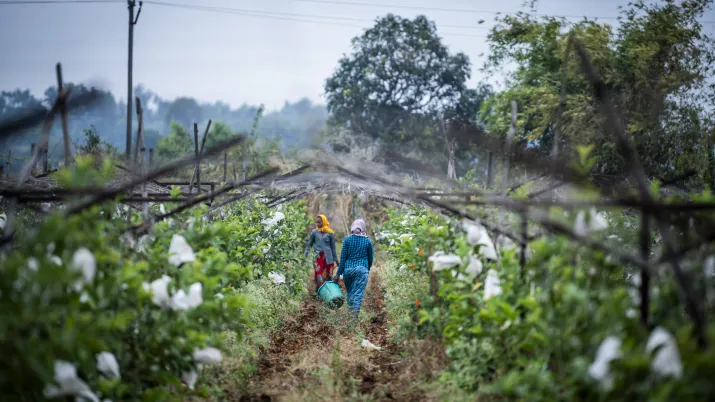
In the Indian state of Maharashtra, the Sahyadri Farms (a farmer collective owned company) – supported by Proparco – has managed to build a network of 50,000 smallholder farmers and become the country...
Published on January 14, 2026
Further reading

How emerging countries innovations can scale climate resilience for all
Published on November 25, 2025