
Share the page
AXA Climate: modelling climate risks, adapting crops
Published on
Romain Cocault Head of the AXA Climate Agri-Transition Team AXA Climate

Private Sector & Development - Business & Climate: Acting to transform
Proparco has published a new edition of its Private Sector & Development magazine, focusing on the strategic role of the private sector and financial institutions in tackling the climate emergency.
AXA Climate has used its modelling tools and agronomic expertise to identify the impacts of climate change on crops at Sahyadri Farms and propose ways of adapting.
What methodology did you use to assess climate impacts on grape and tomato crops in the region concerned?
In order to model climate impacts on these two crops in the Nashik region, AXA Climate teams combined agronomic with climate modelling expertise. First we conducted an analysis of the climate needs and sensitivities of the varieties used by Sahyadri, enabling us to select the most relevant metrics and thresholds for each variety studied. This selection, developed in the lab based on agronomic research and AXA Climate expertise, was subsequently discussed, finessed and validated by Sahyadri’s teams.
We then fed this data into climate modelling applications developed by AXA Climate scientific teams. These are based on the latest generation of international climate models (CMIP6) and can be used to forecast each agronomic indicator for 2030 and 2050 based on two IPCC scenarios (SSP2-4.5 and SSP5-8.5).
Sahyadri has already begun to work on the study’s recommendations, particularly in terms of variety selection, and 95% of plots will switch to more resistant varieties by 2027.
- Head of the AXA Climate Agri-Transition Team

What are the main climate threats identified for these two crops in the short, medium and long term?
The study highlighted the main impacts of climate change on these sectors in the Nashik region. The risks associated with heavy rainfall will increase: climate change will cause the monsoon season to become shorter and more intense and to move to later in the year, posing a risk during the flowering season. The risk of flooding will therefore increase. Conversely, the risk of drought will be greater during the dry season, which will impact crops. Lastly, increased humidity and higher temperatures will make the development of mildew more likely
How are these risks likely to affect crop yields, quality and profitability for smallholder producers affiliated to Sahyadri?
First, yields will be affected, to a greater or lesser degree depending on the resistance of the varieties used by Sahyadri. Fruit quality will also be affected, particularly due to more intense heatwaves. Lastly, climate change will also impact producers and their work through reduced access to fields due to flooding, the worrying effects of heat stress on producers’ health, etc.
Does the study include specific adaptation recommendations for Sahyadri Farms?
Yes, several adaptation recommendations were drawn up in liaison with Sahyadri teams. Three key measures were prioritised. Selecting the best varieties is essential. This had already been initiated by Sahyadri and the use of the most resistant varieties was identified as a priority measure. It is also important to deploy farming practices that enhance resilience, prioritising less tillage and the use of cover crops. Lastly, precision irrigation systems need to be deployed.
How do you assess Sahyadri’s current capacity to implement these recommendations?
Sahyadri has already begun to work on the study’s recommendations, particularly in terms of variety selection, and 95% of plots will switch to more resistant varieties by 2027. The cooperative has also begun to deploy drip irrigation systems on most of its plots (95%).
Key findings of the AXA Climate study at Sahyadri Farms
Key takeaways
• Climate risk is already impacting production, and this risk will only increase between now and 2050.
• The main risks will be tied to changes in monsoon patterns, drought and temperatures, impacting yields and quality
• Sahyadri Farms has already implemented adaptation practices.
Points to be monitored
• Deployment of these practices will be key to Sahyadri Farms’ resilience (variety selection, precision irrigation systems and adaptation of farming practices).
• Aside from risks to crops, climate change will also impact the organisation of production (access in the event of flooding) and producer health (heat stress).
• Risk sharing through financing practices and the provision of technical support will be essential components in facilitating the transition for farmers.

Read the reportage Sahyadri Farms
In India, vineyards faced with climate change
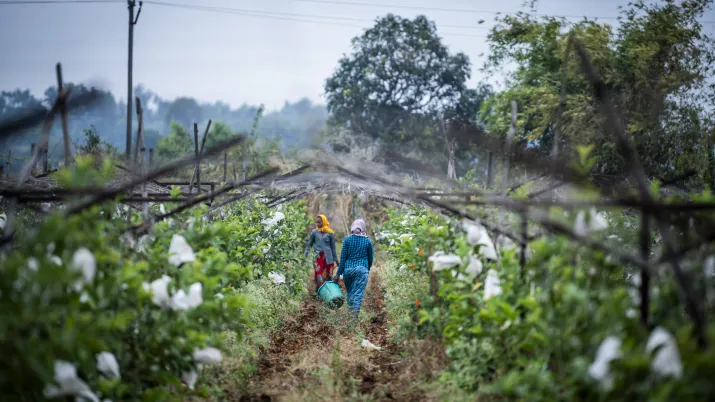
In the Indian state of Maharashtra, the Sahyadri Farms (a farmer collective owned company) – supported by Proparco – has managed to build a network of 50,000 smallholder farmers and become the country...
Published on January 14, 2026
Further reading

How emerging countries innovations can scale climate resilience for all
Published on November 25, 2025