Share the page
Start-ups: raising funds successfully in emerging markets
Published on

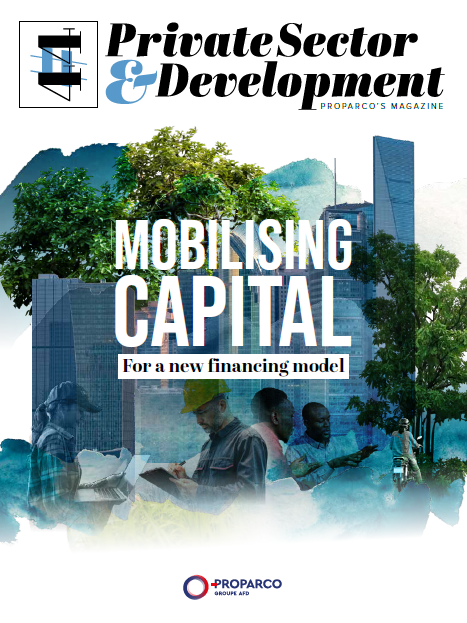
Private Sector & Development #44 - Mobilising capital: for a new financing model
How can we scale up the mobilisation of private capital? While investment needs in developing countries run into trillions of dollars and public resources are no longer sufficient to meet these, the involvement of private investors has become essential.
Venture capital has become a strategic growth driver. In emerging markets – where investors are still a rare commodity – raising funds successfully is not just about securing capital. First you need to build a solid business and choose the right partners.
Becoming a ‘unicorn’ – one of those tech companies valued at over a billion dollars – is what many start-ups dream of. But there is still a long way to go before a start-up can even dream of joining this very exclusive club. First it needs to fund its first product, win over its first customers and then secure the capital needed to boost growth. In emerging markets, this journey is more demanding than elsewhere. The United States is now home to more than 1,700 unicorns, compared with over 130 in India but just nine across the entire African continent, almost all of which are fintechs.
These figures alone demonstrate how far behind emerging markets lag when it comes to accessing venture capital. This gap does not reflect any lack of innovation but rather the scarcity of capital available to fund start-ups. Africa still accounts for only around 1% of global venture capital investment, while nearly 80% of financing for African start-ups comes from foreign investors, mainly from Europe and North America. Gabriel-Iannis Aïssou, Principal with Proparco’s Venture Capital teams explains that “There are fewer investors, fewer specialised funds and therefore greater competition for access to funding.”
The initial investment thesis isn’t always the one that ultimately creates value. If the founders know how to pivot, find new markets or new opportunities, the investment can succeed even if the original story changes.
- Principal Venture Capital, Proparco
Yet there have been successes. In 2024, the Nigerian start-up Moniepoint became not only Africa’s eighth unicorn but a leading fintech specialising in payment solutions for small businesses. It raised US$ 200 million in 2025 from investors such as Proparco, DPI, IFC, Visa and Google’s Africa investment fund. Similarly, South African neobank Tyme Bank, indirectly backed by Proparco, became Africa’s ninth unicorn in the wake of its merger with Brazilian fintech Nubank. In Brazil, Nubank, which provides a fully digital service, has become one of the leading retail banks: from initial fundraising of US$ 2 million in 2013, its valuation had risen to nearly US$ 50 billion eight years later. Nubank is therefore a benchmark for fintech success, on a par with Revolut. Behind these successes lie several years of hard work and a journey marked out by decisive milestones to win over markets in which capital remains scarce.
More than just an idea: a solid business
In emerging markets, investors have a lower appetite for risk than in more mature ecosystems. “In the United States, some start-ups can raise Series A funding with just a pitch deck. In Africa, the market is much more demanding. By Series A stage funding, the company must already be much more robust,” explains Gabriel-Iannis Aïssou. According to a study by the National Bureau of Economic Research (NBER), only 10% of listed start-ups in emerging markets, excluding China, have obtained venture capital funding. And yet they account for nearly half of all research and development expenditure.
Investors are therefore looking not so much for a good idea as for an innovation that meets a real need and can find a market. So the first question is not whether the idea is innovative, but whether it meets a need that is great enough to create a market. “Does your product meet a real need, at an affordable price? Each time someone chooses your product, they are giving up something else” explains Arul Thomas, a partner at Lightrock. Moses Mukundi, CEO of Eden Care, a Rwandan start-up, considers it is essential to understand why customers choose his product and why they continue to buy it. “When customers return seeking clearly identified added value, your start-up is no longer just a promising idea but a business with strong growth potential. That’s the foundation on which you can build a business”, he stresses.
Public development banks are not like other investors
The investment of a public development bank in a start-up’s capital has a ‘catalytic effect’. Its presence reassures the market, reduces perceived risk and encourages other investors to follow suit. Beyond financial returns, these institutions seek to develop a deeper venture capital market by sharing risks with private investors.
At Proparco, this strategy involves both direct investments in specific startups – generally from Series A funding onwards – and the financing of venture capital funds. “Historically, Proparco has provided a lot of support to funds, because this creates a multiplier effect. If we invest €10 million in a fund, that fund can finance 10 to 15 start-ups”, explains Gabriel-Iannis Aïssou. Since 2018, Proparco has therefore invested over €200 million in the tech ecosystem of emerging markets, nearly threequarters of which has been channelled into venture capital funds.
In a funding round, a DFI’s contribution goes beyond mere financial support. Its presence enhances the start-up’s credibility in the market. “When a development bank takes a stake in a company, it signals that the company is sufficiently robust to attract an institutional investor. This can reassure investors in subsequent rounds”, stresses Gabriel-Iannis Aïssou. A DFI also complements the role of the lead investor thanks to its knowledge of emerging markets, its network of partners and ability to open doors for companies, banks or public institutions. For a start-up in the growth phase, this support can prove just as valuable as the funding itself.
The team before the bottom line
Developing a product offering adapted to the market takes time. Even before looking to raise funds, entrepreneurs often spend several years building their business. Nascent businesses must first emerge from the ‘messy middle’ – that period when everything is still experimental. As Neha Kumar, cofounder of littlefish explains, “While you’re spending time meeting investors, you’re not developing your business. You need to gain in maturity and demonstrate the viability of your business. The figures must speak for themselves.”
This first phase is generally funded by the founders themselves, their personal networks or by business angels. “They put in tens of thousands of euros to enable the company to finalise its product, hire its first employees and, if possible, sign its first contracts,” explains Gabriel-Iannis Aïssou. At this stage, this initial funding enables the company to hire the few key people needed to develop a technology, ensure its robustness and begin to market it. At littlefish, this phase took several years. This South African fintech was founded in 2021 to develop software that enables banks to better serve SMEs using payment data, but it did not really begin marketing its technology until 2023.
It was only after securing partnerships with several major South African banks that it launched its first round of funding with institutional investors, raising €2.5 million worth of seed funding. The capital is then used to boost the company’s growth rather than to prove that its product works.
Funds specialising in early-stage investment then step in, despite the still high risk involved: the start-up may only have a handful of early customers, and an order book or revenue still in the hundreds of thousands of dollars. The sums raised – generally between US$ 1 million to US$ 5 million – are used to recruit more staff, improve the product and finance 18 to 24 months of growth, to give the company time to attain critical mass before seeking further investment. To convince these investment funds, the founders present a pitch deck – a presentation outlining the target market, the product, the team and the company’s development opportunities. “At this stage, nobody knows exactly where the company will be in three years’ time. What investors want to know is whether the product meets a genuine market need and if the team has the capacity to develop that product and grow the business,” summarises Gabriel-Iannis Aïssou.
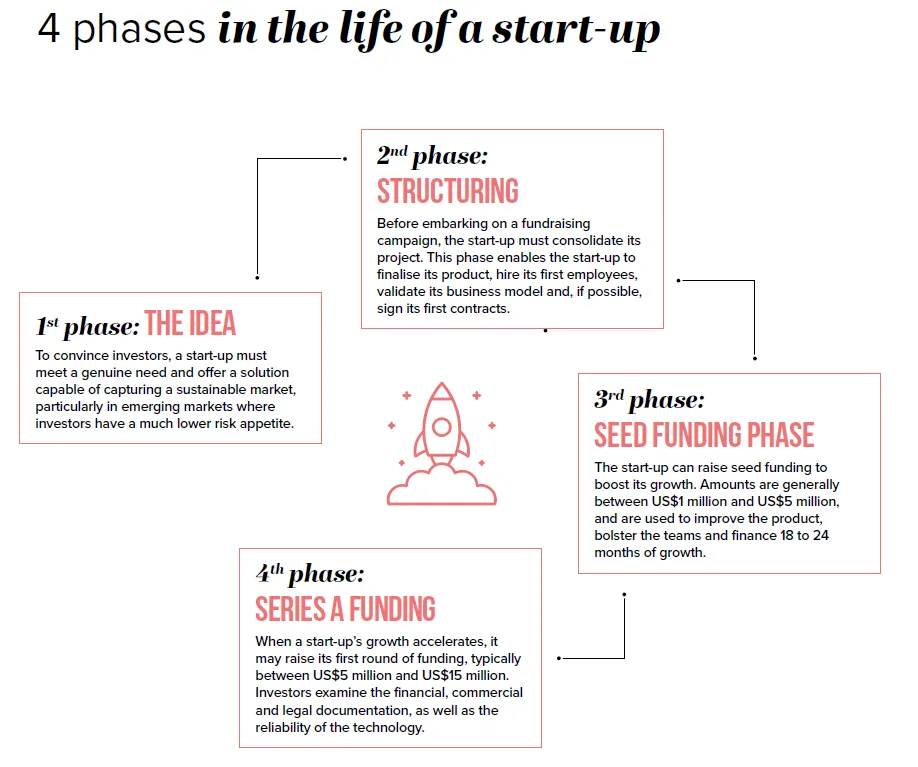
If there is good growth, Series A stage funding comes a few years later, the first major institutional round of fundraising. Amounts raised generally range from US$5 million to US$15 million, and the requirements become more stringent. Before investing, funds carry out due diligence and analyse key financial, commercial and legal documents, while ensuring the reliability of the technology developed. But aside from the figures, the founding team remains a key factor in the investment decision. “For Series A funding, the first criterion we look at is still the team. We’re looking for experienced entrepreneurs who know their sector. Failures often help to avoid repeating the same mistakes,” confides Gabriel-Iannis Aïssou.
In venture capital, a founder capable of adapting is sometimes more precious than a perfect business plan. “The initial investment thesis isn’t always the one that ultimately creates value. If the founders know how to pivot, find new markets or new opportunities, the investment can succeed even if the original story changes,” he continues. Moniepoint’s story is a good illustration of this ability to adapt. It was initially funded to develop a money transfer business but gradually became one of the leading players in the Nigerian payments sector before expanding into lending to SMEs using the data generated by its platform. This ability to evolve its business model was largely due to the experience and technical skills of its founders, both of whom previously worked at Interswitch, one of Africa’s first unicorns, where they gained solid expertise in payment infrastructure.
At littlefish, the two founders, Brandon Roberts and Neha Kumar, have several decades’ of combined experience in financial software, payments and banking partnerships. But a team is more than just the sum of its founders’ backgrounds. As Joseph Hurst-Croft, Managing Director of ARC Ride points out, “The founder isn’t the only person responsible for the company’s vision. You have to know how to build a team, avoid micromanagement and trust the people who will also champion that vision.” Technology can be copied but a team capable of executing a strategy and adapting to the market is much harder to replicate.
Investors rather than mere financiers
However, building a solid business is not enough to successfully raise funds. You still need to convince investors. In emerging markets, this is trickier than elsewhere because little capital is invested in tech innovation. In the absence of a sufficiently robust local ecosystem, many entrepreneurs expand their search for funds to Europe or the United States.
“Where there is a strong diaspora, such as in Nigeria or Morocco, some people can use their connections, but when an entrepreneur only has local roots, they really have to roll up their sleeves and knock on every door”, explains Gabriel-Iannis Aïssou. Once doors have been opened, you need to choose which ones to walk through. Neha Kumar, cofounder of littlefish believes that “It’s not just about the money. It’s what investors bring to the table in addition to funding.” She feels that knowing how to combine several sources of funding and bring together complementary investors is now a key challenge. This means that in light of the political, regulatory and macroeconomic risks, start-ups in emerging markets are exposed to a greater level of risk than elsewhere. They must ensure they have a diverse range of investors offering a variety of responses to potential exogenous shocks.
It’s not just about the money. It’s what investors bring to the table in addition to funding.
- Cofounder, littlefish
So in a funding round, each investor plays a different role. The lead investor – usually a venture capital fund – needs to partner the management team on a day-to-day basis. They are particularly involved in strategy. Around them, development banks, DFIs, corporate funds and public investors contribute their networks, sector-specific expertise and good governance, or facilitate access to new markets. As Gabriel-Iannis Aïssou puts it, “The founder not only needs to choose the offer that attaches the highest value to the business, they must also choose the investors who will add the most value.”
littlefish has built its shareholder base with this in mind. From its first rounds of funding, the fintech has been backed by Tlcom, one of the continent’s leading early-stage funds, and by Flourish Ventures, which is world-renowned for its fintech expertise. Series A funding was subsequently provided by Partech with the participation of Proparco. “Partech and Tlcom help the company with strategy and business development. Flourish Ventures brings strong fintech expertise. Proparco contributes an institutional perspective, its banking network and access to new markets,” explains Gabriel-Iannis Aïssou. For a company that sells its software to major African banks, the involvement of a development finance institution (DFI) goes way beyond the question of funding. “When a development bank acquires a stake in a start-up, it signals to the market that the company is robust enough to attract an institutional investor. This can reassure investors for subsequent rounds of fundraising.”
Keeping your hands on the wheel
Choosing the right investors is all the more important insofar as, with each round of fundraising, the founders give up a portion of their equity. The aim is to maintain a shareholder base that will support the company’s growth without hampering the founders’ ability to steer the business. “A common mistake is to surround yourself with investors who don’t contribute very much. They acquire a stake in the company but don’t really support its development,” notes Gabriel-Iannis Aïssou. At Proparco, this question forms an integral part of the analysis. “In Series A, we look carefully at the stake still held by the founders after investment. They often keep around 40% of equity, then about 30% in Series B. They need to remain aligned with their business and retain a genuine capacity to take action.”
The timing of fundraising is just as crucial. When littlefish closed its US$ 9.5 million Series A round, it was already working with several major banks, generating recurring revenue and still had cash reserves. “We weren’t raising funds because we were short of money. We were doing it to accelerate growth,” summarises Neha Kumar. This type of forward planning makes it possible to negotiate from a position of strength. A company with only a few months’ cash reserves risks having to accept a lower valuation or more restrictive terms, whereas a start-up with several years’ visibility can choose its partners and take the time to negotiate.
The same note of caution applies to valuation. In markets where investors are rare, seeking the highest possible valuation can quickly turn into a trap. If the company then has to raise funds at a lower valuation, a “down round” sends a negative signal to the market and complicates subsequent rounds of funding. Gabriel-Iannis Aïssou believes that “It is better to build a solid business, with sound fundamentals, capable of weathering crises, rather than seeking the maximum valuation too quickly.”
In these markets, where nearly 80% of financing still comes from foreign investors, each round of fundraising does not just concern the success of a single company. “In the United States or Europe, when start-ups become drivers of the economy, some of the wealth created is reinvested in the ecosystem. Successful entrepreneurs often become business angels and partner other entrepreneurs. That is what helped create Silicon Valley,” notes Gabriel-Iannis Aïssou. Elsewhere, this virtuous circle is only just beginning to take shape. By nurturing entrepreneurs, investors and new funds, each success gradually helps to strengthen a nascent ecosystem. In emerging markets, a successful round not only finances a specific business – it also makes it a little easier for the next business to raise funds.
5 mistakes that can jeopardise a funding round
- Raising funds too early: in emerging markets, investors rarely just fund an idea. Before starting to raise funds, a start-up must have validated its product, won over its first customers and demonstrated that its business model actually works.
- Choosing money over partners: the best investor isn’t always the one offering the highest valuation. The most valuable investors are often those who support the founders over the long term, open up their network, contribute sector-specific expertise and step up when the company faces difficulties. A good investor is a partner, not just a shareholder.
- Losing control: each round of funding involves a dilution of control. Gabriel-Iannis Aïssou reiterates that “A common mistake is to bring in investors too early who don’t contribute much. They take a stake in the company but don’t really support it.” Holding onto a significant stake allows the founders to remain in control and retain their ability to act.
- Waiting until your back is against the wall: raising funds when cash reserves are almost exhausted puts the company in a position of weakness. Conversely, having several years’ visibility allows you to choose your investors, take the time to negotiate and secure better terms.
- Being tempted by an excessively high valuation: a really high valuation is flattering, but it can become a trap. If the company fails to justify this valuation during its next round of funding, a “down round” sends a negative signal to the market and complicates future funding.
Interview
“The figures should speak for themselves”, Neha Kumar and Brandon Roberts from littlefish
From preparing for a fundraising round to understanding investors' expectations, Brandon Roberts and Neha Kumar, co-founders of the South African start-up littlefish, share the key factors for success...
Published on November 2, 2026

To go further

Beacon Power Services: harnessing data to drive Africa’s energy transition
Published on April 23, 2026

Further reading

“Mobilising capital – For a new financing model”: the latest issue of Private Sector & Development
Published on November 2, 2026