Share the page
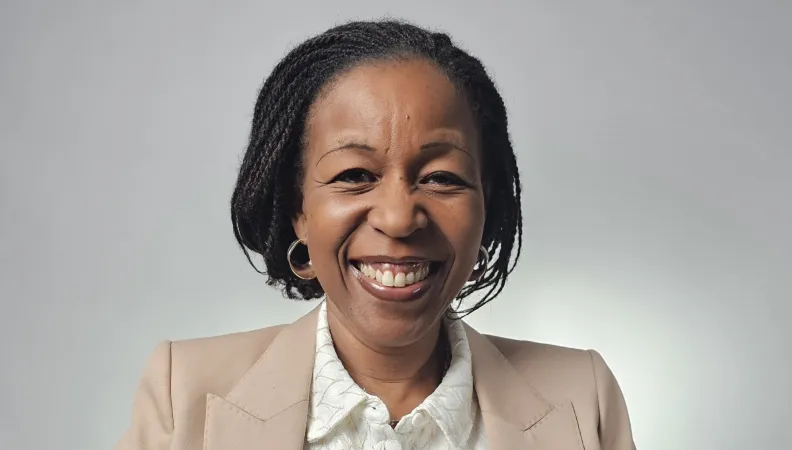
Making finance a catalyst for transformation with Yedau Ogoundele
Published on
Private Sector & Development #44 - Mobilising capital: for a new financing model
How can we scale up the mobilisation of private capital? While investment needs in developing countries run into trillions of dollars and public resources are no longer sufficient to meet these, the involvement of private investors has become essential.
For nearly twenty years, Yedau Ogoundele had been working behind the scenes in global finance – in Paris, London, on trading floors, in corporate and investment banking, and for Bloomberg. It was a career that many people could only dream of. Yet she chose to change direction because she was increasingly confronted by a nagging question: what is the point of finance if it does not tangibly improve people’s lives?
This conundrum led her to return to West Africa with a simple conviction: the financial tools capable of shifting billions on the international markets can also enable a family to buy their first home. Since 2023, she has been putting this conviction into practice as CEO of AFINHAB (formerly CRRH-UEMOA), a regional financial institution dedicated to financing housing in West Africa. AFINHAB was set up on the initiative of the Central Bank of West African States (BCEAO), the West African Development Bank (BOAD) and the Financial Markets Authority of the West African Monetary Union (AMF-UMOA), and has become one of the key players in housing finance across the eight countries of the West African Economic and Monetary Union (UEMOA). Its mission is to provide refinancing to banks to enable them to offer long-term mortgages where such financing was previously lacking. It is, undeniably, a complex financial mechanism, but its effects are remarkably simple: enabling more families to become homeowners.
Real-world impact as a guiding principle
As Yedau Ogoundele explains, “What interests me is the tangible impact.” For Yedau, this is no mere slogan. When she discusses her career, she does not speak of a break between two trajectories, but rather a sense of continuity. Her years in investment banking taught her about how capital markets work, institutional investor expectations, governance requirements and the mechanisms involved in large-scale financing. Bloomberg provided a global perspective on international markets and asset management. However, as her career progressed, another goal began to take shape. “At one stage, I asked myself what the point of my work was. Did I simply want to help to make already very wealthy investors even richer, or put this expertise to use for something more tangible?” The answer to this question resulted in her moving back to West Africa.
Networking to improve access to housing
Yedau is originally from Benin and she knows this region intimately and is well aware of its enormous needs. Above all, she knows that the main challenge is not so much raising capital as managing to channel it into useful projects. She likes to sum up this mission in a single sentence: “My strength lies in my ability to build bridges” – bridges between international investors and African realities, between capital markets and local needs, and between the language of risk familiar to financiers and that of social impact so cherished by development institutions.
This ability to connect worlds that are still largely unfamiliar with one another has become her number one skill. When AFINHAB’s Board offered her the role of CEO in 2023, she was not stepping into uncharted territory. Having already been a member of the Board for two years, she had chaired a committee tasked with drawing up a new strategic plan designed to boost the organisation’s impact. “But there’s a world of difference between devising a strategy and actually deploying it”, she notes with a smile.
Scaling up to meet demand
When she took the reins, the organisation had around fifteen staff members. Within three years, headcount was up to nearly thirty. This growth is not an end in itself: it reflects a shift in scale, as the challenge AFINHAB is tackling is colossal. Across the eight UEMOA countries, population growth, rapid urbanisation and the extremely young demographic are fuelling a demand for housing that the markets are struggling to meet. Every year, hundreds of thousands of households attempt to become homeowners, but mortgage lending remains scarce and often inaccessible, due to a lack of long-term financing within the banking system. The contrast with Europe is striking. “In France or the UK, when you want to buy a home, you compare the rates offered by the different banks. In West Africa, the first question is often much simpler: is there a bank capable of providing a mortgage?” In the absence of a solution, many families proceed at a pace dictated by their savings. They buy a plot of land, put their project on hold for several years, take out a loan to build a few rooms, then start again. Becoming a homeowner is a journey that can take several decades.
An organisation that inspires and empowers
This vicious circle is precisely what AFINHAB is seeking to break. Since its creation in 2010, the organisation has mobilised over 475 billion CFA francs in refinancing (around €720 million), enabling more than 100,000 people to become homeowners. But Yedau Ogoundele rarely treats these figures as a financial achievement. She prefers to talk about the people behind them. “When a family tells you: ‘I never imagined I’d become a homeowner’, you immediately realise why you do this job.” She believes that this is where finance rediscovers its primary purpose, namely creating opportunities. But she still needs to convince those who provide the capital! A large part of her day-to-day work therefore involves talking to international investors, regional banks, pension funds and market regulators. This is where her international experience is a key advantage.
This persuasive ability was particularly apparent during the first social bond issue in 2025 for a total of 60 billion CFA francs (approximately €90 million), dedicated exclusively to affordable housing in West Africa, in which Proparco participated as lead investor. For Yedau, this transaction marked a turning point for the regional market. “Proparco not merely provided capital, it sent out a signal of confidence to the entire market. Its commitment signified that the project had been analysed from every angle – governance, financial soundness, risk management and social impact – and that it met international standards. This endorsement acted as a real catalyst and helped to attract new regional investors, be they pension funds, banks, insurers or savers keen to add a social dimension to their investment portfolio.”
As far as AFINHAB’s CEO is concerned, this gradual mobilisation of private capital is one of the key regional housing development levers, however, she refuses to rest on her laurels.
5 key dates
1968 Born in France to Beninese parents
1990 Graduated from EM Lyon Business School
1993 Entry into corporate and investment banking
2010 Joined Bloomberg in London
2023 Appointed CEO of AFINHAB (formerly CRRH-UEMOA)
Securitising receivables to free up credit
Yedau’s aim is to continually expand the range of financing solutions. It was with this in mind that, in June 2026, AFINHAB, alongside BOAD Titrisation, Ecobank and Proparco, partnered the region’s first multi-originator securitisation transaction, backed by residential mortgage loan portfolios. As Yedau explains, “This technical innovation is underpinned by a simple idea: enabling banks to refinance their mortgage loans in order to free up new lending capacity and finance more housing.” This is yet another example of her commitment to bringing tools that have been tried and tested on international markets to West Africa, whilst adapting them to local conditions.
This perseverance comes as no surprise to those who know her. A few years ago, when she suggested developing the concept of securitising mortgage loans in the region, several observers informed her that the idea was premature, if not impossible. She chose to see this as yet another reason to press ahead. This ability to pursue an idea in spite of scepticism is undoubtedly one of her most striking personality traits. “I hate anything that pretends to have an impact,” she confides.
A special focus on women
The same pragmatism guides her approach to team building. When she took over the reins at AFINHAB, Yedau noted that most positions of responsibility were still held by men, as is the case across much of the financial sector, but she refused to accept the inevitability of this situation. Convinced that the necessary skills already existed within the organisation, she set up a female leadership development programme, combining mentoring, individual coaching and career development support for female employees. Her aim is not to create specific career paths, but to remove the barriers that frequently prevent women from taking the next step. As she points out, “Often, the main obstacle isn’t a lack of skills but a lack of self-confidence.”
This focus on women is also reflected in the way AFINHAB measures its impact. The organisation tracks the proportion of women benefiting from the financing it helps to raise, convinced that home ownership is also a powerful driver of economic empowerment.
Ultimately, its ambition goes far beyond simply financing housing. It seeks to demonstrate that African capital markets can become vectors for large-scale development, capable of addressing issues as vital as housing – provided they remain connected to local needs. A new strategic plan is currently being prepared to scale up AFINHAB’s activity. It recognises that the institution on its own cannot resolve the worsening housing shortage that continues to afflict the region. Banks, institutional investors, development partners and public authorities will need to move forward in unison. However, she remains convinced that finance can play a decisive role, provided it never loses sight of its ultimate purpose. For Yedau Ogoundele, the financial aspects of a project are not an end in themselves – what really matters is the moment when a line of funding turns into a set of house keys handed over to a family. That, she says, is when finance assumes its full meaning.
What people say about her
Aimé Savadogo, Deputy CEO, AFINHAB
“What strikes me most about her leadership style is her ability to combine a clear strategic vision with rigorous execution. She knows where she wants to take AFINHAB based on a strategic plan deployed in 2023 and, above all, she knows how to rally the teams around its objectives by empowering each and every one. As John C. Maxwell – one of the most influential figures in the field of leadership – puts it, she embodies the type of leader who ‘…knows the way, goes the way and shows the way’.”
Michael Tapsoba, Country Representative for Benin, Togo and Mauritania, Proparco
“She is one of the leading female personalities in the sub-region. What is striking is her determination to pass on her knowledge and help other women progress. I have seen this through SIRA (‘path’ in Bambara), AFINHAB’s female leadership programme launched in March 2026, which supports women throughout their careers, builds their confidence and helps them access positions of responsibility. AFINHAB has also set up an in-house mentoring and support programme to nurture female talent, with the aim of extending this initiative beyond the organisation. You can tell that this is not just a token gesture, but a genuine commitment.”
Mirabelle Robert, Officer for Delegated Financing, Technical Support
and Blended Finance division, Proparco
“What sets Ms Ogoundele apart is her strategic vision and her resolutely proactive approach. She recognised the potential of Proparco’s proposed technical support programme, seized this opportunity and successfully adapted it to the specific needs of AFINHAB (formerly CRRH-UMEOA), turning it into a genuine vector for development and impact. This same vision is apparent in the way she forges her partnerships. She attaches great importance to long-term relationships, based around trust and a genuine spirit of collaboration.”
Video
Voices for Change - Yedau Ogoundele, CRRH-UEMOA
In this episode of Voices for Change, Yedau Ogoundele, CEO of CRRH-UEMOA, shares a strong belief: housing is not only about Shelter, it is the foundation of stable, inclusive and sustainable developme...
Published on May 27, 2026

Further reading
Benin: Proparco and IFC support AXIAN and Sika in financing 62 MWp of new solar capacity
Published on November 2, 2026
“The figures should speak for themselves”, Neha Kumar and Brandon Roberts from littlefish
Published on November 2, 2026