
Share the page
Proparco invests in CarbonFarm to reduce methane emissions from rice farming
Published on
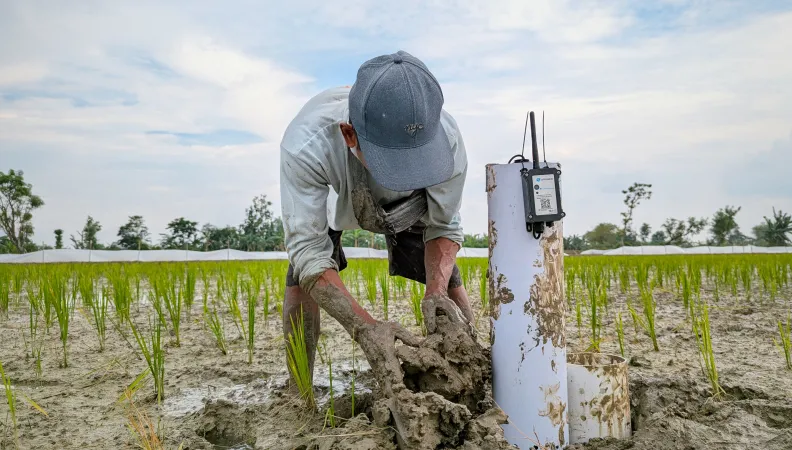
As methane reduction becomes an increasingly prominent issue on the COP31 agenda, Proparco announces a €1 million investment in CarbonFarm. The French startup, which specialises in decarbonising rice production, uses satellite technology and artificial intelligence to make methane emissions reductions measurable, verifiable and scalable. Made as part of CarbonFarm’s Series A funding round, the investment aligns with Proparco’s Natural Capital strategy and will enable the company to accelerate the deployment of its solution in emerging markets.
Rice farming remains a largely overlooked opportunity in the fight against climate change. Rice production accounts for approximately 12% of global methane emissions, contributing nearly 1.5% of the overall warming effect of greenhouse gases.
Methane is the second-largest contributor to global warming after CO₂ and has a particularly strong warming effect in the short term. Rapidly reducing methane emissions is therefore an important way to slow the pace of global warming over the coming decades.
Reducing methane emissions and water consumption
Much of these emissions comes from traditional rice cultivation methods. Keeping rice paddies flooded for extended periods creates anaerobic conditions in the soil, which promote methane production. A relatively simple agricultural practice known as Alternate Wetting and Drying (AWD) offers an alternative by alternating periods of irrigation with controlled drying of the fields.
Adopting this practice can reduce methane emissions by around 50% and water consumption by approximately 30%, without requiring major changes to farming systems. It therefore offers considerable potential, particularly in regions already facing severe water constraints. The technique also provides climate adaptation benefits: by stimulating root development, it helps strengthen rice plants and makes rice farming more resilient to climate change.
A French startup combining climate technology and agriculture
Founded in 2022 by Vassily Carantino and James Hastwell, CarbonFarm aims to decarbonise rice production, notably by enabling farmers to benefit from financial incentives linked to their emissions reductions. To achieve this, the startup combines climate expertise, satellite data and artificial intelligence.
Vassily Carantino, CEO and co-founder, previously worked on sustainability and climate issues at McKinsey, following an earlier career in data and technology. James Hastwell, CTO and co-founder, specialises in data science and the development of products based on large-scale data analytics.
The founders identified a key challenge: while agricultural practices that reduce emissions from rice production already exist and are scientifically documented, scaling them up across large numbers of smallholder farmers requires reliable ways to verify that changes in farming practices have actually taken place and to quantify their impact.
This is where CarbonFarm's expertise comes in: making emissions reductions measurable, verifiable and scalable.
Monitoring rice paddies from space to measure their climate impact
CarbonFarm has developed a digital Measurement, Reporting and Verification (MRV) solution that uses satellite imagery and machine learning, among other technologies.
The technology makes it possible to remotely monitor certain agricultural practices, particularly water management, and use these observations to quantify greenhouse gas emissions. The aim is to generate more reliable, independent data that can be used at scale, including for projects involving large numbers of smallholder farms.
CarbonFarm also supports agricultural stakeholders throughout the various stages of carbon project development, from data collection and management to emissions reduction quantification, certification and the generation of value from carbon credits.
By making project monitoring simpler and less costly, this approach aims to help agribusinesses and their local partners develop programmes that encourage rice farmers to adopt lower-emission practices.
Carbon finance can therefore help fund the transition: verified emissions reductions can generate revenue to provide payments to farmers, finance the support they receive and enable the continued adoption of new practices. This is particularly important for the vast majority of smallholder farmers, given that the average area under rice cultivation per farm in Asia is around 1.15 hectares.
A further example of Proparco's Natural Capital strategy in action
This investment forms part of Proparco's Natural Capital strategy, which aims to mobilise more private finance for the conservation and restoration of ecosystems and the sustainable use of natural resources.
The strategy focuses on three main areas: forest and mangrove conservation and restoration; sustainable agricultural land management; and the development of sustainable and regenerative practices for marine ecosystems.
Through its investment in CarbonFarm, Proparco is supporting a new generation of French climate tech companies that harness technology and data to deliver solutions in emerging markets. More than 90% of CarbonFarm's current clients and projects are located in countries where Proparco operates, particularly in Asia.
Vassily Carantino, CEO and co-founder of CarbonFarm:
“We are seeing a significant increase in interest in decarbonising rice production, both in voluntary carbon markets and through regulated carbon market mechanisms. Recent commitments by Amazon and Google in this sector reflect this growing awareness. As one of the superpollutants, methane deserves a much more prominent place in corporate climate strategies, alongside investments in CO₂ capture. Decarbonising rice production delivers several major benefits: reducing emissions, saving water, improving farmers' incomes and strengthening their resilience to climate change.
We are delighted to partner with Proparco, one of the most active development finance institutions in carbon markets, to mobilise carbon finance and accelerate the adoption of sustainable rice farming practices at scale around the world.”
Jean-Gabriel Dayre, Head of Proparco's Natural Capital Division:
“Reducing methane emissions is one of the key ways to deliver significant climate benefits in the near term, and rice farming offers considerable potential in this respect that remains largely untapped. CarbonFarm fully embodies the ambition of our Natural Capital strategy: to support science-based solutions capable of transforming agricultural practices and delivering positive, measurable impacts for the climate, natural resources and smallholder farmers.
We are particularly pleased to support this French startup, which is harnessing innovation, satellite imagery and data to address a global climate challenge, with the potential to deploy its solution at scale across emerging and developing countries.”
The project benefits from the EDFI Carbon Sinks guarantee, managed by EDFI Management Company and funded by the European Union under the EFSD+ programme, in support of the EU's Global Gateway strategy.