Share the page
Financing adaptation: anticipating risks to create value
Published on
Private Sector & Development - Business & Climate: Acting to transform
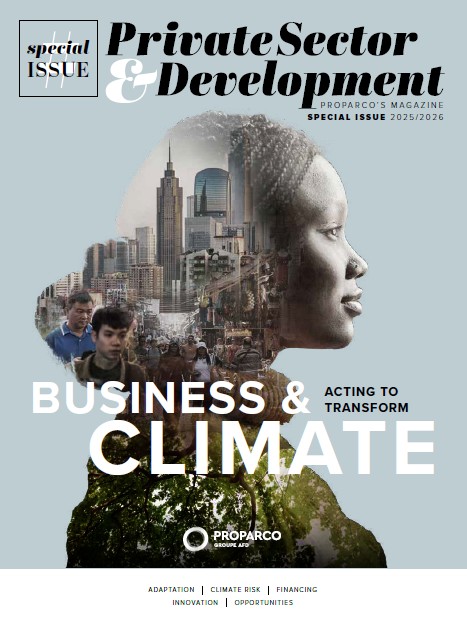
Proparco has published a new edition of its Private Sector & Development magazine, focusing on the strategic role of the private sector and financial institutions in tackling the climate emergency.
To be truly effective, the private sector’s contribution must be based on fairness and a long-term approach. This implies a pricing of risk that reflects the real costs of exposure without penalising the most vulnerable entities and populations, as well as a shared governance of resilience between businesses, governments and communities.
By integrating adaptation into strategic planning, product design and operational management, the private sector can turn climate constraints into competitive advantages. In doing so, it not only protects its assets, but also becomes a key player in collective resilience, contributing to an economy that can absorb shocks and bounce back in the face of future climate uncertainties.
Climate risks: a reality for infrastructure
Climate change poses a direct threat to infrastructure. In Uganda, Serengeti Energy, an independent power producer operating in nine sub-Saharan African countries, experienced two major floods in 2023, resulting in over €4million worth of damage to its two hydroelectric power plants located on the Nyamwamba River. As Marian Grabowski, Head of commercial operations explains, “When a project is in the development phase these risks sound relatively abstract but in practice, they completely mess with your returns and financial models.”
In India, “one of the countries most threatened by climate change,” Purvi Bhavsar, Co-founder of Pahal Financial Services (India), discusses the damage caused in several places on the subcontinent. “Half a million people were recently affected by torrential rains in Punjab, India’s breadbasket.
Entire villages were wiped from the map in a just minute.” In Mauritius, the effects of global warming are also already very tangible, explains Thierry Hébraud, CEO of Mauritius Commercial Bank (MCB): rising sea levels (4.7 mm a year since 1987), floods, cyclones, drought and heat waves. “Last year, one of my staff had to climb out of his car window to escape a flood,” he says. The consequence of this climate change for the island is accelerated erosion of the beaches in a country that depends on tourism and financial services for half of its GDP. Mauritius’ investment needs are enormous: USD 6.5 billion by 2030, including USD 4.5 billion for climate adaptation. Thierry Hébraud notes that “65% cannot be mobilised without international support.”
On the other side of the Atlantic in Brazil, in 2024, the Rio Grande do Sul region experienced its worst flooding in 80 years. Vinci Compass, an alternative asset manager, saw 10% of the pylons along a 200 km transmission line that it owns and operates collapse. José Guilherme Souza, Associate director at Vinci Compass, recounts that “Several power utility assets were affected for a number of operators and some of our towers were completely destroyed.” Insurance covered 90% of the losses, but «our premium more than doubled the following year, and fewer and fewer insurers are willing to insure assets in these types of regions.”
Solutions and challenges for increased resilience
Faced with these disasters, it is not just a matter of repairing, but of anticipating. Marian Grabowski of Serengeti Energy explains that, “We received very good support from Proparco when we signed the technical assistance agreement last year, just to gain a better understanding of the key drivers here in Uganda.” One of the first conclusions of the study conducted following the floods shows that a major fire in 2012 at an altitude of 4,000 metres in the Rwenzori Mountains led to a massive influx of sediment. At this altitude, forest regeneration takes years.
Serengeti Energy is therefore exploring adaptation solutions: closer monitoring of sediment, sensors to automatically shut down power stations, and repositioning of blocks of rock . The conclusion is clear: “uncertainties related to risks must be factored in when selecting a site, and operating teams must be trained to manage them”, insists Marian Grabowski. But data quality remains a challenge in Africa, where “sometimes there is only one weather station which has maybe 50 years worth of data, but it’s also not necessarily located directly where your asset is located. With climate change, historical weather data no longer provides reliable forecasts.”
In India, the economic potential of adaptation is ‘enormous,’ according to Purvi Bhavsar, particularly in three sectors: agriculture (which still provides a livelihood for 60% of the Indian population), infrastructure and health. She adds that, “In agriculture alone, the investment requirement for adaptation will reach USD 200 billion by 2030 – particularly in agritech and weathertech, to provide real-time weather information to farmers. And to reach the most vulnerable people, community microfinance is the preferred solution: 99% of our customers are women, who are the most exposed and vulnerable section of the population. The efforts and investments required in this particular segment are therefore much greater.”
In Brazil, Vinci Compass has opted to design new pylons with raised foundations and it has created the Vinci Climate Change Fund dedicated to sustainable ‘greenfield’ infrastructure (in other words, those built from scratch). José Guilherme Souza recounts that “With the help of our investors and certain European development finance institutions, we have developed a climate framework to help us assess and rate risk prior to any investment.” This framework generates ESG action plans and monitoring indicators. He adds that, “The aim is to conduct better informed negotiations with banks, insurers and contractual counterparties around ESG risks.”
Proparco actively encourages this type of anticipation, which can make assets more attractive to buyers, lenders, governments and regulators. Meridiam’s rehabilitation of the Transgabonese road illustrates this approach. Mete Saracoglu, Director of Operations for Africa at Meridiam believes that “this is the ideal situation – where you are designing a new greenfield infrastructure and have to incorporate physical risks that can occur through climate change.” Thanks to a detailed risk assessment, the project incorporated a reinforced drainage system, materials adapted to heat variations and raised sections.
In total, these adjustments represented an additional cost of USD 20 million on a USD 400 million project, or about 5%. But, as Mete Saracoglu points out, “thanks to the intervention of AFD and Proparco, this additional cost was financed by a climate loan on very competitive terms. These additional costs are therefore amortised over the term of the concession, which reduces the risks. It remains to be seen how this will translate in practice over the next 30 years.”
Demystifying climate adaptation finance: measuring, tracking, replicating
Banks can integrate transition-related physical risks into lending procedures and portfolio committees. This is the solution chosen by Standard Bank, Africa’s largest banking group, with a presence in 21 countries. As Maureen Harrington, Vice-President of Standard Bank explains, “We’ve embedded climate and physical transition risk indicators into our environmental and social policies. But the key is to help our customers respond to risks with credible transition plans.”
Standard Bank recognises this massive funding gap – “only 5% of adaptation needs are covered” – and it sees “95% opportunity”. The institution has set itself concrete targets: 2.3 billion rand (approximately USD 135 million) has already been lent to 845 farmers to support smart agriculture. Maureen Harrington explains this integrated approach: “We help farmers to earn carbon credits for what they’re doing to mitigate their risks and we’ve set up a carbon trading desk.” She also advocates for a stronger role for donors: “We can accept country risk, but how can we mitigate – or who is willing to pay for or bear – the risk associated with growing trees? Donors and public institutions need to come up with solutions for the risks that banks cannot yet absorb.”
As Paul Smith, Consultant with the UNEP Finance Initiative (UNEP FI) notes, “Many private actors are already financing climate resilience without knowing it.” He believes this invisibility makes it difficult to identify best practices and assess their scope: “The problem is, if we don’t know how to track the flows, how can we identify case studies and, more specifically, how can we replicate them? The UNEP FI, via its working group on adapting the Principles for Responsible Banking, has therefore developed operational guidelines to help banks integrate resilience into their portfolios, focusing on the most vulnerable sectors such as agriculture and real estate. The aim is to “get from risk to value”. According to Paul Smith, there are two distinct levers: “resilience of”, i.e. protecting existing assets, and “resilience through”, which involves financing solutions that enable other players to adapt (irrigation, early warning systems, etc.). He stresses that: “First movers in this field are also those that learn fastest. And this should be a circular process, so start small, but aim high.”
Thierry Hébraud contends that when it comes to adaptation, the private sector can be very proactive. “It is the private sector that keeps Africa’s economies going. MCB is already present at the heart of the solution by financing agriculture, infrastructure and water management. But Africa only accounts for 4% of emissions despite having 20% of the world’s population. It must not be abandoned faced with a crisis it did not create.”
Adaptation as sustainable growth driver
Adèle Cadario, Global Lead for Infrastructure and Nature-Based Solutions at the Global Centre on Adaptation, warns that, “The greatest risk is not taking future climate conditions into consideration when you design your project.” Out in the field, there are growing numbers of examples of the real cost of inaction and the benefits of resilience. Last year in São Paulo, Brazil, torrential rains brought 25 transport lines to a standstill and plunged entire neighbourhoods into darkness. As Karina Whalley, Head of Public Sector at AXA Climate, explains, “We have found that without adaptation measures, by 2050, all of these risks could reduce the net value of assets by 26% in a worst-case scenario. With adaptation, this loss can be reduced to 4%, factoring in the cost of adaptation measures.”
Adaptation begins by assessing risks and understanding vulnerabilities based on location, type of assets and activities, and then continues with adjusting existing financial products to meet identified adaptation needs. Adèle Cadario believes that, “It’s not just about seeing how the project will impact the environment, but also how future climate conditions and the environment will, in turn, impact assets and their operations.” In her view, this approach may require “a higher initial capital outlay – sometimes 10 to 20 per cent higher – but it secures assets and prevents damage from future climate events.” It can even generate value.
This equation is being proven on a large scale in India with Sahyadri Farms, a limited liability company controlled by a cooperative that brings together over 50,000 farmers in the state of Maharashtra (see report on page 57). This company, which is supported by Proparco, has made resilience the core of its model by integrating solutions such as resistant seeds, smart irrigation, waste management and the use of renewable energies, etc. In just a few years, Sahyadri has become a flagship of the Indian economy, with agricultural revenues up 60%, margins doubled and a leading position in exports in spite of extreme climate change. Aside from economic results, smallholder farmers have gained autonomy, income and access to finance, while strengthening their ability to cope with climate hazards.
For Adèle Cadario, the lesson is clear: “Reaching the most vulnerable communities – those already most affected by climate change – is an integral part of the adaptation agenda. This requires financial institutions and intermediaries to deploy specific solutions capable of reaching these most vulnerable people. This is where adaptation and financial inclusion meet.”
Further reading
Proparco invests in CarbonFarm to reduce methane emissions from rice farming
Published on October 15, 2026
With Support from Proparco and the AfDB, Qair Installs 30 MW of Solar Capacity in Chad
Published on September 25, 2026
Proparco and Grupo Enhol partner to advance Peru’s solar energy transition with landmark Illa project
Published on September 24, 2026