
Share the page
Bond issues: the keys to a successful transaction
Published on

Private Sector & Development #44 - Mobilising capital: for a new financing model
How can we scale up the mobilisation of private capital? While investment needs in developing countries run into trillions of dollars and public resources are no longer sufficient to meet these, the involvement of private investors has become essential.
Whereas bond issues were long the preserve of governments and large corporations, they are now becoming a genuine alternative to bank debt for companies in emerging economies. But raising funds on the capital markets cannot be done just like that and critical scale, the backing of lead arrangers and support from anchor investors are all essential conditions.
In June 2025, Axian Telecom (now Yas Group) raised US$600 million on the international bond markets, heralding the reopening of the bond market for African issuers following a particularly turbulent first half year. Despite a climate dominated by geopolitical tensions in the Middle East and political uncertainty in the US, the issue was almost three times oversubscribed. A few months later, in Argentina, Genneia raised US$400 million in the largest ever international green bond issue by a private company in the country. Proparco acted as anchor investor in both transactions, reflecting a gradual transformation of the capital markets. Long the preserve of governments and large corporations, these markets are now opening up to companies in emerging economies.
According to the OECD, the outstanding bond debt of these companies has increased by a factor of 8.5 since 2008. However, this trend remains highly uneven. For example, African companies only account for around 1% of global corporate bond debt, whereas the continent generates nearly 2.5% of global GDP. In most emerging economies, bond markets have not put down deep roots, with a limited number of issuers and a still-narrow investor base. Therefore, in most of these economies, bank credit remains the main source of financing. However, according to the OECD, emerging economies will need to mobilise more than US$ 10,000 billion dollars in additional investment by 2050 to finance their climate transition and no banking system will be able to meet this need on its own.
Bond markets therefore appear to be an increasingly essential source of funding for attracting international investors, but gaining access to them is by no means straightforward. As Matias Kalfon, Principal Investment Officer, Proparco notes, “There are structural constraints on accessing the bond market, such as the size of companies, credit ratings and the depth of the markets. But there is also a lack of understanding of this resource. Many companies still feel that bond markets are not for them.” Rob Mason, Head of Debt Capital Markets at Standard Chartered, points out that successful transactions such as that of Axian Telecom blaze a trail and give other companies the confidence they need to access international bond markets. However, it is still vital to master the key phases.
Our role is not merely to provide funding; it is above all to send a signal of confidence to the market.
- Principal Investment Officer, Proparco

Scaling up
A bond issue is, above all, another way of financing growth. Rather than approaching one or more banks, the company addresses investors in the capital markets directly in order to access larger sums. As Pauline Dubin, Investment Officer in charge of Energy and Telecoms at Proparco puts it, “Bond markets offer a depth that banks cannot match. They broaden your range of potential investors by providing access to pension funds, insurance companies, asset managers and investment funds.”
This broader investor base allows issuers to diversify and secure better financing terms. Matias Kalfon considers that “In the case of Axian Telecom, initial market indications pointed to a yield of around 8%, before strong demand allowed the final coupon to be set at 7.25%. This was a dual success as it enabled Axian not only to reduce its cost of funding but also to free up investment capacity for its operations.” A bond issue also makes it possible to structure financing that is better suited to the company’s needs by offering greater visibility through a fixed rate, more flexible repayment terms and covenants that are generally less restrictive than those imposed by bank loans.
Bond markets offer a depth that banks cannot match.
- Investment Officer in Energy and Telecoms, Proparco

Several months of preparation
However, this method of financing is not suitable for all companies. The process involves lead arrangers, credit rating agencies, law firms, auditors and numerous other consultants, and it generates significant fixed costs. As Matias Kalfon explains, “If a company is looking to raise US$ 50 million or US$ 100 million, it doesn’t generally make sense. But, when it needs to raise US$ 400 million or more, the bond markets become a viable option. Transaction costs can then be absorbed by the size of the operation.”
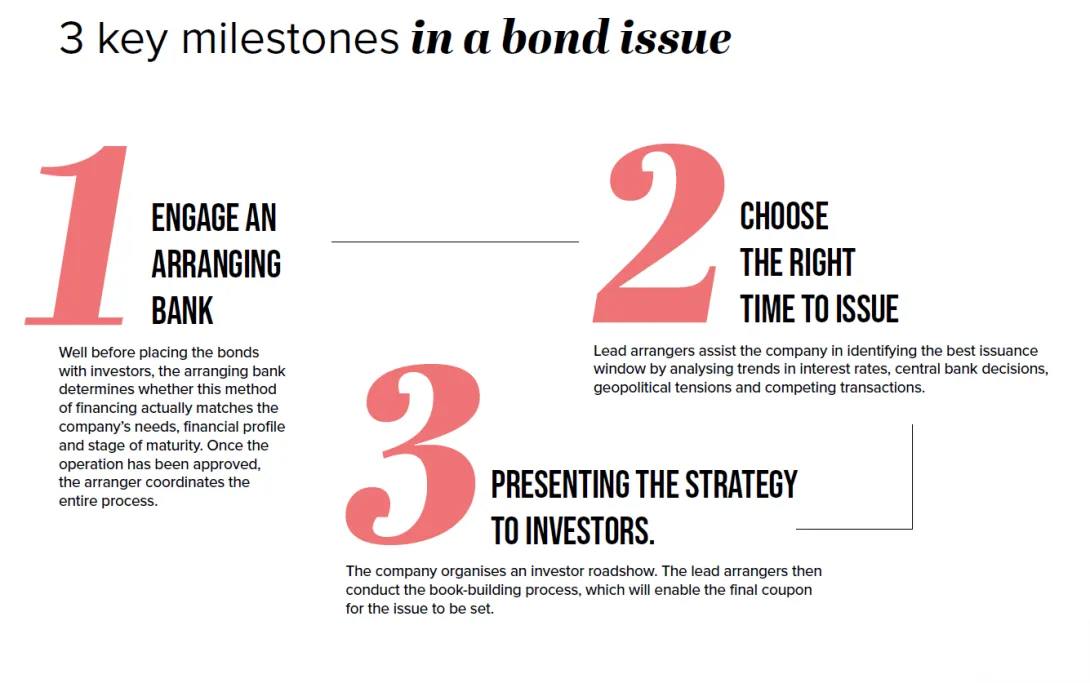
The first step is therefore to engage an arranger bank. Well before placing the bonds with investors, the bank determines whether this method of financing actually matches the company’s needs, financial profile and stage of maturity. Rob Mason: “An international bond issue requires critical size, a solid financial profile and a sufficiently mature organisation to meet investors’ requirements. At Standard Chartered, we first assess the suitability of the product before discussing the pros and cons with our clients. It is not uncommon for these discussions to last six to nine months before a decision is even taken.” Once the operation has been approved, the advisory bank coordinates the entire process: obtaining credit ratings, preparing the legal and financial documentation, drafting the Offering Memorandum and organising meetings with investors. The Offering Memorandum is similar to the prospectus for an initial public offering and it collates all the information on which investors will base their decision.
However, even when perfectly prepared, a bond issue remains dependent on market conditions. Banks therefore need to monitor interest rate movements, central bank decisions, geopolitical tensions and competing issues on a daily basis in order to identify the best window of opportunity. Rob Mason stresses that “The better prepared a company is with its ratings and documentation, the better placed it will be to seize the first favourable market window. This is what we call managing market risk.” Once this window has been identified, things move pretty quickly. Within a few days, senior management present their strategy to investors at a roadshow, before the lead arrangers manage the book-building process, which will determine the final coupon rate for the issue.
An international bond issue requires critical size, a solid financial profile and a sufficiently mature organisation to meet investors’ requirements.
- Head of Debt Capital Markets, Standard Chartered

Anchor investors: a signal to the market
In emerging economies, impeccable preparation and a seamlessly managed timetable are not enough to guarantee the success of an issue. In addition to the company’s performance, investors also assess the risk associated with the country in which it operates. It is precisely to reduce this perception of risk that development finance institutions enter the equation. Several months before the issue, they perform their own due diligence, covering financial aspects as well as environmental, social and governance (ESG) criteria. If their findings are positive, they announce their participation as anchor investors, even before the order book opens. Matias Kalfon explains that “Our role is not merely to provide funding; it is above all to send a signal of confidence to the market. Investors know that Proparco or other institutions have performed all the necessary due diligence and are ready to invest. This reduces the perception of risk and attracts other investors.” So, even before Genneia’s order book had opened, Proparco and FMO had committed to subscribing to amounts of US$ 30 million and US$ 60 million, respectively. “This sent a very positive signal to the market. These institutions are recognised for the quality of their financial and non-financial analyses. By investing themselves, they endorsed both the transaction and the offer price”, notes Pauline Dubin.
For development banks, however, the success of an international bond issue is only the first step. The aim is then to enable companies to gradually begin raising funds on their own bond markets. “The next step is to replicate what has been achieved on the international markets, only on the local markets”, explains Matias Kalfon. The stakes are pretty high. In many emerging economies, companies generate the bulk of their revenue in local currency but continue to take on debt in dollars or euros. Any depreciation of their local currency therefore automatically increases their cost of debt. But developing domestic bond markets mobilises more local savings, reduces dependence on external financing and strengthens companies’ resilience. This shift is already underway, although progress remains a mixed bag. While South Africa and Nigeria already have relatively well-developed bond markets, many other countries are still building their ecosystems. Nevertheless, the trend is under way. In Kenya, Safaricom launched the first tranche of its 40 billion Kenyan shilling domestic bond programme at the end of 2025 – the largest issue ever authorised for a company in the country. The transaction, which raised 20 billion Kenyan shillings thanks to strong investor demand, shows that local markets capable of financing large companies are gradually beginning to emerge. Aside from the amounts raised, these issues are the first building blocks for creating deeper and more liquid local capital markets, capable of providing sustainable financing for companies in emerging economies into the long term.
Further reading
“Our growth warranted accessing the capital markets directly”
From accessing international bond markets to the emergence of African capital markets, Hassan Jaber, Group Chief Executive Officer of Yas (formerly Axian Telecom), discusses the challenges and opportu...
Published on November 24, 2026

Also read
As Colombia faces an unprecedented El Niño episode, Davivienda and Proparco mobilise US$125 million through a...
Published on November 20, 2026
Proparco grants a €75 million loan to QNB Leasing to support Türkiye's energy transition
Published on November 16, 2026