Share the page
African Private Fellowship program: building the next generation of African investors
Published on
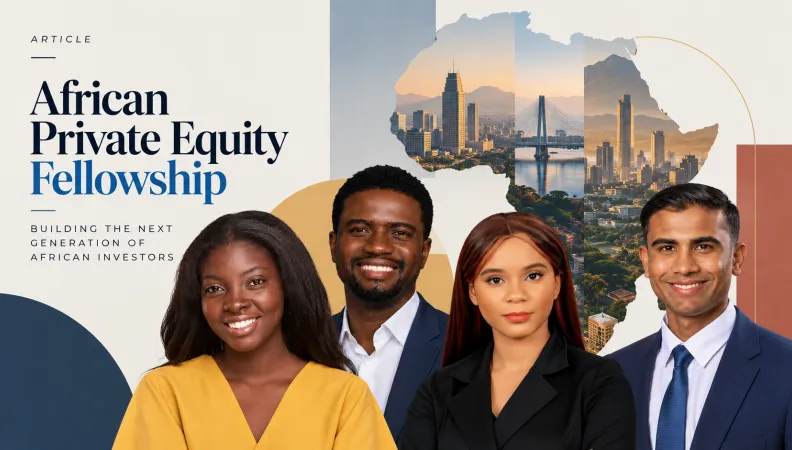
The Fellowship is an unprecedented training and networking program designed by Proparco, the Africa Commission of France Invest and the AFD Campus. In the following interview, four alumni speak of their experiences of the Program. These include their motivations for joining the Fellowship, the impacts it has had on their careers, how it differentiates investing in Africa, as well as memorable experiences and insights.
The interview brings together four alumni from different Fellowship cohorts: Sarah Inem, an investment professional and Global MBA candidate at IE Business School, from Cohort 1 (2022); Emmanuel Egyam, an MBA candidate at Stanford Graduate School of Business and former Associate at Adenia Partners, from Cohort 2 (2023); and Leo Doolooa, Investment Associate at African Infrastructure Investment Managers (AIIM), and Thelma Carr, Investment Associate at Verod Capital Management, both from Cohort 3 (2024).
What motivated you to join the African Private Equity Fellowship?
Sarah Inem: When I joined the Fellowship, with a background in corporate finance and technology, I had just started working in private equity. At the time, there was nothing comparable on the continent. That it was backed by AFD and Proparco gave it credibility: I wanted to deepen both my technical knowledge and my understanding of private equity beyond West Africa. The Fellowship’s combination of private equity and venture capital content was exactly what I was looking for – my long-term ambition has always been to build an African venture capital fund for high-growth startups.
Emmanuel Egyam: On joining the Fellowship, I had already spent several years in private equity. I had come to realise that the industry is fundamentally apprenticeship-based. You learn by hearing from people who have faced challenges, made mistakes and found solutions. That was my first motivation. Secondly, I wanted to better understand Northern and Southern Africa – my experience was concentrated in Western and Eastern Africa – through the eyes of practitioners there.
Leo Doolooa: I joined the Fellowship early in my career, shortly after entering the private equity industry. Unlike many finance professionals, I had not followed the traditional investment banking path. The Fellowship appealed to me because it offered exactly what I was missing: practical learning, exposure to markets and sectors beyond my own, and a community of young professionals facing similar challenges across Africa.
Thelma Carr: My experience was largely limited to West Africa. I wanted to understand how investing worked across the rest of the continent: how deals were structured, how investors approached value creation, and whether the challenges we faced were unique to our region or shared across Africa. I was also keen to broaden my exposure beyond traditional private equity by learning more about venture capital, ESG and the legal aspects of investing.
Looking back, what has the Fellowship brought you, and how has it shaped your career?
Sarah Inem: The Fellowship gave me much more than technical knowledge. It strengthened my understanding of both private equity and venture capital, while exposing me to experienced African investors who shared practical lessons from transactions they had personally led. Hearing real-life examples of value creation and investment decisions made the learning far more relevant than purely theoretical content. Professionally, it also helped prepare me for my transition from a regional investment role in West Africa to an international role in Europe focused on technology and data.
Emmanuel Egyam: The Fellowship met all my expectations. What stood out was learning from practitioners who had faced the same challenges we had encountered in private equity. The value creation sessions in particular, fundamentally changed the way I think about investing because they were based on real companies, real decisions and real constraints. Equally important was the community. The relationships built during the programme continue today through discussions, collaboration, and efforts to strengthen the alumni network. The Fellowship, while improving technical understanding, also reinforced the collective responsibility of our generation to shape the future of African private equity together.
Leo Doolooa: Early in one’s career, so much of private equity is about building foundations – learning the language of the industry, understanding transactions, and developing the confidence – which the Fellowship instilled in me – to express an investment view. The Fellowship accelerated this process. It exposed me to experienced practitioners, practical case studies and different investment approaches, while allowing me to learn alongside peers at a similar stage of their careers.
Thelma Carr: The Fellowship exceeded my expectations. The learning went beyond the formal sessions. While the speakers, MOOCs and case studies were valuable, what surprised me was how much I learned from my fellow participants. The programme broadened my perspective by exposing me to venture capital thinking, strengthened my collaborative leadership style and encouraged me to approach investment decisions more holistically. Since completing the Fellowship, my responsibilities have expanded to include championing AI adoption initiatives firmwide. The programme gave me the confidence and network to take on these broader leadership responsibilities.
The Fellowship met all my expectations. What stood out was learning from practitioners who had faced the same challenges we had encountered in private equity.
- MBA candidate at Stanford Graduate School of Business and former Associate at Adenia Partners
In your personal and professional experience, what makes investing in Africa different?
Sarah Inem: A lot of people investing in African startups are not necessarily African. They may be investing from New York or elsewhere, and they do not always understand the key challenges in African markets. Over the past couple of years, we have seen a number of large Western venture capital firms exiting the continent. I think that this has been a bit of an awakening. More African investors are stepping in because they live here; they understand the problems they are trying to solve. For African investing, it is crucial to have local people involved. They understand the region, and they are better placed to identify solutions than outside investors. The Fellowship also changed my understanding of what best practice means in an African context: the African speakers were sharing what they had actually seen and done.
Emmanuel Egyam: The first challenge for me is fundraising. We still rely heavily on DFIs, and I hope we will continue to see more local investors – pension funds, family offices and entrepreneurs – buy into the value that private equity brings. The second challenge is currency fluctuations, which are a major issue when you are raising funds in one currency and investing in another. Then there is value creation. In Africa, this takes time. The systems, the institutions and sometimes the talent available make it a longer process than in more developed markets. Finally, exits are a big challenge. The universe of buyers is relatively small, so we need more private equity firms, more diversified exit strategies and stronger capital markets. Where we are doing better is in creating real operating value. We do not have the luxury of relying on leverage, so we have to focus on growing revenues, improving margins and cash flows, strengthening governance and ESG, and helping companies create real value.
Leo Doolooa: Africa is a continent with more than 50 countries, and each one has its own unique risks, cultures, history, and nuances. This needs to be understood through an investment lens – concerning both risk and opportunities. Taking this approach makes doing business and investing on the continent harder, but also more meaningful.
Thelma Carr: In Africa, you have to pay closer attention to the macro environment, including inflation, foreign exchange, government policies, and how these could affect businesses. You also have to understand the people running the companies. Many entrepreneurs may not have formal business backgrounds, but they understand their industries deeply through years of practical experience. Access to information is another challenge, as reports and data are often not readily available. This means you have to speak to experts, spend time in the market and sometimes see things for yourself before making an informed investment decision. That hands-on approach is what makes investing in Africa different.
The Fellowship promotes gender equality within its cohorts. Sarah and Thelma, has the program boosted your confidence as young women in the sector?
Sarah Inem: Finance, and private equity in particular, remains a male-dominated industry. There are still relatively few women in the industry. Programmes like this show that women belong in these spaces. Knowing that I have the knowledge to back up my thoughts has boosted my confidence. Having participated in the programme, and as a result, having access to a network of top investors across Africa has also strengthened my confidence.
Thelma Carr: I work in a firm where women are well represented, including in leadership positions, so I have been fortunate to have strong women role models throughout my career. The Fellowship reinforced for me how important that representation is, especially through the Women in Private Equity seminar. Hearing other women speak openly about the challenges they had faced in the industry and how they had navigated them gave me a broader perspective beyond my own firm. At the same time, it reminded me that my experience is not the reality for many women in the industry and that there is still work to be done. That is why I am passionate about supporting other women and creating opportunities for them to grow in the industry.
Hearing other women speak openly about the challenges they had faced in the industry and how they had navigated them gave me a broader perspective beyond my own firm
- Investment Associate at Verod Capital Management

Which learning experience has stayed with you the most?
Sarah Inem: One of the biggest takeaways for me was understanding that investing in Africa requires local knowledge. The Fellowship also gave me much greater confidence in my understanding of venture capital, and I still draw on these insights and experiences in my work today.
Emmanuel Egyam: Hearing directly from people who had done it, who shared real situations and how they approached them, was incredibly valuable. The biggest learning for me was how to think through investment challenges and create value, and this was afforded through the Fellowship’s apprenticeship approach.
Leo Doolooa: Learning to think about Africa as a collection of very different markets was a key takeaway. The Fellowship reinforced the importance of questioning assumptions, understanding each country, and approaching investment decisions bearing in mind these nuances. The practical discussions with experienced investors helped build this mindset.
Thelma Carr: The case studies stayed with me the most. I liked that it gave me the opportunity to learn through how other people thought about the same problem and to see how things could be approached differently across markets. It also reinforced for me that investing in Africa requires a hands-on approach. You have to understand the macro environment, spend time in the market, speak to experts and build a real understanding of the businesses you are investing in.
The Fellowship reinforced the importance of questioning assumptions, understanding each country, and approaching investment decisions bearing in mind these nuances.
- Investment Associate at African Infrastructure Investment Managers (AIIM)
What advice would you give to prospective future Fellows?
Thelma Carr: The Fellowship will be particularly beneficial for professionals who want to better understand the African private equity and venture capital space. Young investment professionals looking to broaden their horizons beyond their home markets and deepen their understanding of how investing works across different African contexts will benefit the most. I would also encourage women who want to build confidence in their abilities and trust in their qualifications to apply.
Leo Doolooa: I would advise taking advantage of the access the Fellowship gives to the expe-riences of others, enabling one to avoid making the same mistakes oneself.
Sarah Inem: I would advise not being afraid to apply. The Fellowship is not just a six-month programme – it is a long-term investment in yourself and your career. Beyond technical knowledge of the African private equity and venture capital space, it connects one to a net-work of alumni and professionals, and provides access to resources.
Emmanuel Egyam: I recommend the Fellowship to anyone interested in private equity, espe-cially for anyone considering a career in African private equity and development. Being con-nected to the continent and driven by the desire to contribute to its development – with the realisation of the impact you can make – will make the learning all the more worthwhile.
The Fellowship is not just a six-month programme – it is a long-term investment in yourself and your career.
- Investment professional and Global MBA candidate at IE Business School

A new phase for the Fellowship
The Fellowship is entering a pivotal phase in its development, with a renewed focus on securing its long-term sustainability and laying the foundations for its next chapter. A key priority will be to bring together leading industry partners to support the program’s growth, broaden its reach and further deepen its impact.
Alongside this effort, the program will undergo a thoughtful redesign, shaped in close collaboration with future partners and our alumni community. By drawing on their experience, perspectives and insights, we aim to further strengthen the curriculum and ensure it remains closely attuned to the evolving needs of the investment industry.
Ultimately, our ambition is to establish the Fellowship as a flagship programme for the development of the next generation of investment talent in Africa — equipping promising professionals with the knowledge, exposure and network they need to thrive and contribute to the continued development of the continent’s investment ecosystem.