
Share the page
Proparco invests in the first fund dedicated to decarbonising the textile industry, alongside the World Bank Group
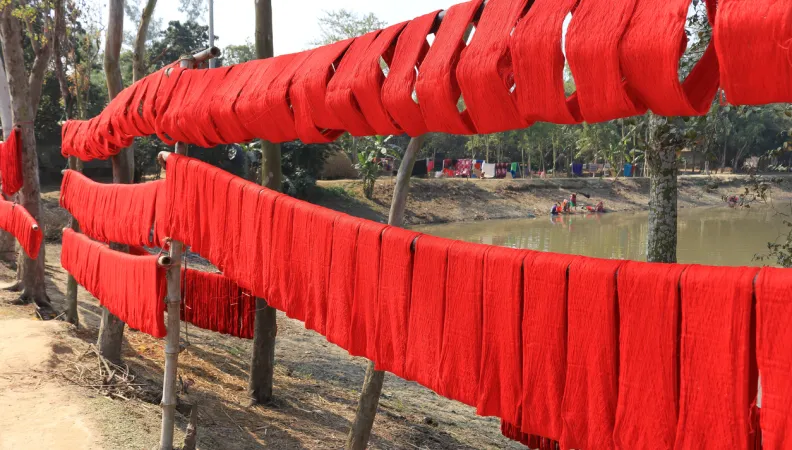
Empowering textile industry suppliers to invest in their environmental transition is the ambition behind the Decarbonisation of Textile, Apparel & Footwear Suppliers (D-TAFS) initiative, in which Proparco announces its participation following the opening of COP31 in Antalya, Türkiye. Supported by the Inditex Group, owner of Zara among other brands, this blended finance fund aims to mobilise up to $400 million, with $225 million raised at the first close.
Proparco is committing to the D-TAFS Fund alongside its European counterparts FMO and BII, with the support of the Inditex Group, owner of the Zara, Massimo Dutti, Oysho and Bershka brands.
As a key partner in the initiative, Inditex is playing a leading role in its deployment by facilitating the Fund's access to its international supplier network and helping significantly reduce the risks borne by other lenders through its commitment. This partnership illustrates an innovative approach to decarbonising the textile sector: supporting a major European player in the environmental transformation of its value chain, while providing its suppliers, most of which are based in emerging and developing countries, with the means to finance their transition.
Developed by Social Investment Managers & Advisors (SIMA), in partnership with the International Finance Corporation (IFC), a member of the World Bank Group, D-TAFS also benefits from the support of the Global Environment Facility (GEF). Its financing also brings together several private investors, including the Apparel Impact Institute's Fashion Climate Fund and insurance company MetLife.
Managed by SIMA, the Fund will provide loans ranging from $2.5 million to $5 million to suppliers in the textile, apparel and footwear industries in developing countries. Its objective is to remove the barriers to financing green investment projects that are holding back their environmental transition, particularly by supporting investment in renewable energy, energy efficiency and wastewater treatment.
Tangible investments to reduce the environmental footprint of the textile industry
The financing will enable production sites to be modernised through more efficient industrial equipment, including solar photovoltaic installations, high-efficiency boilers, heat recovery systems and wastewater treatment solutions.
These investments will help reduce suppliers' energy consumption and, more broadly, their environmental footprint. The projects supported are expected to prevent approximately 8 million tonnes of greenhouse gas emissions over the lifetime of the Fund and save 52 million litres of water every year. These expected results illustrate the textile industry's potential for environmental transformation.
Combining the environmental transition with support for employment in developing countries
Beyond its climate objectives, D-TAFS aims to contribute to economic development and the preservation of jobs in developing countries. Over a 10-year period, at least 60 companies are expected to benefit from this support.
The initiative is expected to help sustain more than 18,700 jobs, while also promoting the creation of new positions. Particular attention will be paid to least developed countries (LDCs), notably Bangladesh and Cambodia, where the textile industry plays an important role in the economy and employment.
This operation is fully aligned with Proparco's strategy to promote a fair and inclusive environmental transition. In addition to its direct financing, it will enable Proparco to extend its activities to 60 to 80 companies further upstream in the textile value chain, while mobilising private capital to support the sector's decarbonisation.
Emmanuelle Riedel Drouin, Deputy Chief Executive Officer of Proparco, said:
"Decarbonising the textile value chain requires major investments in renewable energy, energy efficiency and the circular economy. Through the D-TAFS programme, Proparco is proud to help remove the financing barriers that limit suppliers' ability to make these essential investments in emerging markets, thereby accelerating the sector's transition towards lower-carbon textile production."