Share the page
In Jordan, Proparco supports a landmark project led by Meridiam, Suez and Vinci to address the water challenge
Published on
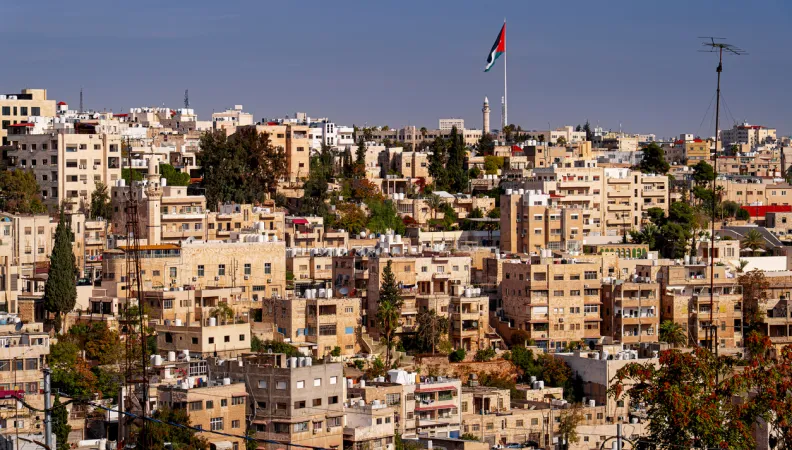
Proparco is contributing to the financing of the Aqaba-Amman project, a strategic infrastructure project designed to address one of the most severe water stress situations in the world. Led by Meridiam and Suez, with Vinci Construction Grands Projets playing a key role in its construction, this USD 6.7 billion project brings together leading French expertise. It will produce 300 million cubic meters of drinking water per year and sustainably strengthen water security for more than four million people in Jordan.
Jordan faces one of the most severe water shortages in the world. With only 61 m³ of water available per capita per year, the country falls well below the international threshold for absolute water scarcity, set at 500 m³. In Amman, residents receive water for an average of only 24 hours per week.
Pressure on water resources has intensified due to the combined effects of population growth, the large influx of refugees from neighboring countries and climate change. Jordan’s population has doubled in twenty years to more than 11 million. The Syrian crisis alone has led to a 40% increase in water demand in the north of the country.
Climate change is exacerbating these pressures through declining rainfall, rising temperatures and evaporation, and reduced groundwater recharge. As a result, freshwater resources could decline by a further 15% by 2040.
Against this backdrop, the gap between water supply and demand is expected to reach nearly 300 million m³ per year, equivalent to the annual needs of approximately four million people.
A landmark project in terms of scale and technological ambition
The Aqaba-Amman project provides a major response to this challenge. It involves the construction in Aqaba, on the shores of the Red Sea, of a reverse osmosis desalination plant capable of producing up to 300 million m³ of drinking water per year, sufficient to cover approximately 40% of the country’s water needs in 2030.
The water will be transported to Amman and other governorates through a 438-kilometer pipeline crossing the country from south to north. The system will have to overcome an elevation difference of more than 1,600 meters, representing a major engineering challenge. The project will also incorporate up to 281 MWp of dedicated solar capacity to cover part of its energy needs.
With a four-year construction period, Aqaba-Amman stands out for its scale and technological and industrial ambition. Once operational, it will provide more than four million people with new or improved access to an essential service and support several thousand jobs during construction and operation.
Leading French expertise at the heart of the project
Aqaba-Amman illustrates the ability of leading French companies to combine their expertise to develop, finance, build and operate large-scale essential infrastructure. Selected by the Jordanian government following a competitive international bidding process, Meridiam and Suez are the project sponsors through the National Carrier Project Company.
As the lead shareholder, Meridiam brings its expertise as a developer and investor in sustainable infrastructure, together with its experience in public-private partnerships, emerging markets and Jordan.
Suez, the project’s industrial investor, is bringing its global expertise in the water sector, notably to the construction and operation of the desalination plant.
Vinci Construction Grands Projets, which coordinates the consortium responsible for the project’s main infrastructure works, will notably contribute its expertise to the construction of the nearly 440-kilometer water transmission system.
From development and financing to desalination and major infrastructure engineering, the project brings together leading French expertise to address a critical challenge for Jordan.
Proparco and Meridiam: partners for sustainable infrastructure
The financing of Aqaba-Amman marks a new milestone in the partnership between Proparco and Meridiam, one of Proparco’s key partners in the infrastructure sector.
Proparco has already supported thirteen projects led by Meridiam, representing more than €500 million in commitments across renewable energy, transport, airport and digital infrastructure, particularly in Africa.
From the Dakar BRT to the Kipeto wind farm in Kenya, the Biovea biomass power plant in Côte d’Ivoire, the Setrag railway in Gabon, Raxio data centers and airport infrastructure in Madagascar, Proparco and Meridiam share a common ambition: to mobilize capital for sustainable and resilient infrastructure that delivers significant benefits for local communities.
With Aqaba-Amman, this cooperation takes on a new dimension around strategic infrastructure for Jordan’s water security and climate resilience.
Françoise Lombard, Chief Executive Officer of Proparco, said: “Alongside our partner Meridiam, we are proud to contribute to this major project for Jordan, in a region particularly exposed to the impacts of climate change and growing pressure on water resources. Supporting infrastructure that improves access to essential services and strengthens the resilience of communities and territories in the face of these challenges is at the heart of Proparco’s priorities.”
International financing on a scale that matches the project’s ambition
The scale of Aqaba-Amman requires significant international financial mobilization. Proparco is working alongside development finance institutions, multilateral banks, export credit agencies and commercial banks.
Proparco is also mobilizing FMO (Netherlands) and DEG (Germany) through the Friendship Facility, illustrating the ability of European development finance institutions to join forces in support of strategic infrastructure.
Involved from an early stage, Proparco participated in the group of banks that supported the Jordanian authorities in structuring the project’s financing. It is now one of the project’s main lenders, alongside AIIB, DFC, IFC, which also mobilized the Green Climate Fund (GCF), the EIB (European Investment Bank) and the EBRD (European Bank for Reconstruction and Development).
This collective effort highlights the essential role of development finance institutions in enabling transformative investments, particularly in regions that are highly exposed to the impacts of climate change.